
| Card Manufacturer | Wills |
| Year | 1938 |
| Series | Speed |
| 2nd Series | |
| # Of Cards In Series | 50 |
| Card Size | T206 (Cigarette Card) 1 7⁄16 by 2 5⁄8 inches (3.7 cm × 6.7 cm) |
I consider this set of tobacco cards from the pre-1950s to be truly iconic. It has cemented its status as a must-have for collectors, boasting immense popularity and a wide selection of impeccably preserved cards available for purchase. The pricing of this set seems to ebb and flow over the years, presenting a challenge when it comes to determining its value. Cards in poor condition have been sold for as little as $3.00 each, while higher grade full sets have fetched $25-30. The pricing appears to fluctuate dramatically, lacking any clear consistency.
Each of these captivating cards boasts a vibrant array of hand-drawn depictions, brimming with a kaleidoscope of colors that bring them to life. Even when translated into dot screen printing, they manage to retain a remarkable level of detail, ensuring that every nuance and flourish is beautifully preserved. It comes as no surprise that these time-honored cards have stood the test of time, captivating generation after generation with their enduring charm and appeal. Notably, they have excelled in the realm of manufacturing, boasting superior centering and alignment compared to their contemporaries. As a result, they have secured a well-deserved reputation for unparalleled quality and craftsmanship, setting a standard that few can rival.
What do you think of this set of cards?
1
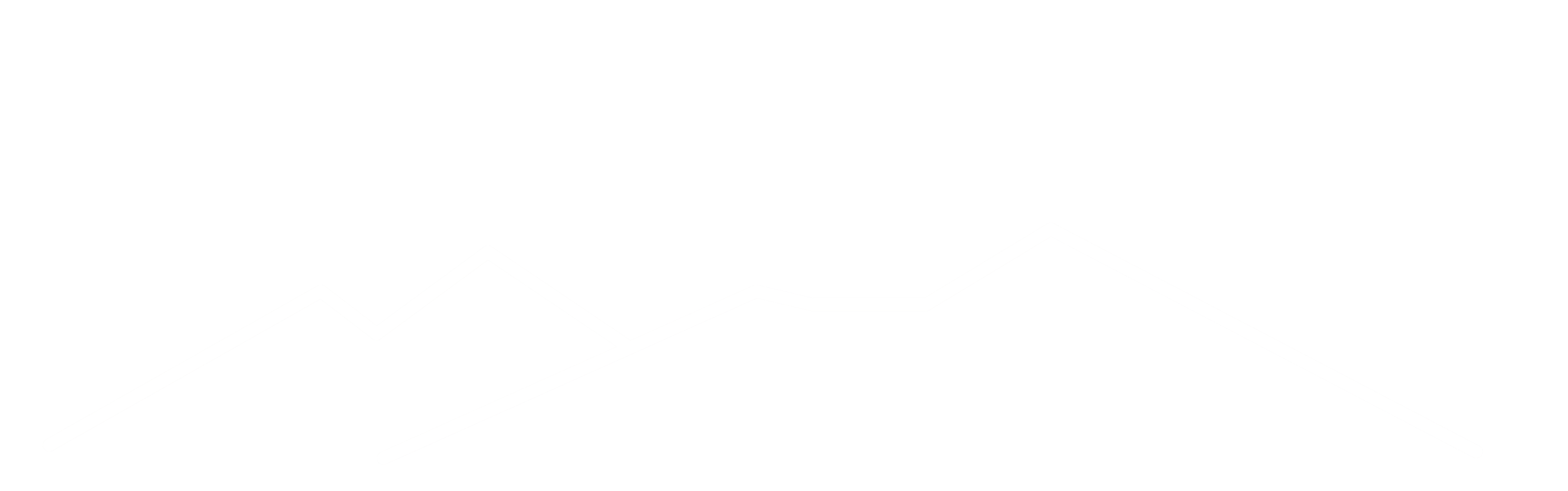
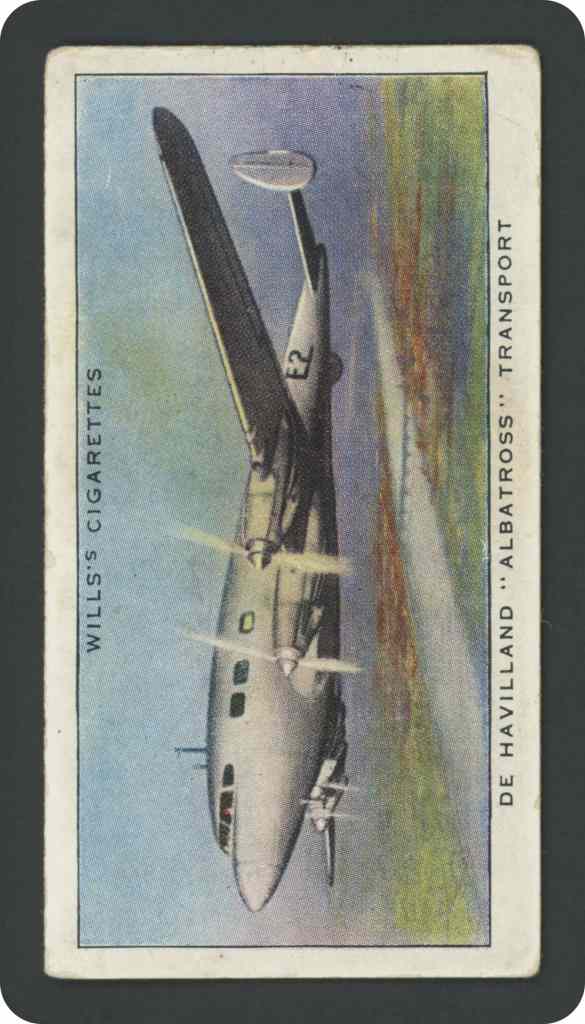
De Havilland “Albatross” Transport
A long-range D.H. 91 “Albatross” aeroplane has been built by the De Havilland Aircraft Co., , Ltd., of Hatfield, for experimental flights by Imperial Airways across the North Atlantic. The idea is to compare the merits of the landplane with those of the flying-boat. The “Albatross” is built entirely of wood and has four 510 h.p. D. H. “Gipsy-Twelve” supercharged air-cooled motors. It is one of the cleanest aeroplanes ever built, and has a cruising speed of 212 m. p.h. and a maximum speed of about 248 m.p.h. on its comparatively low power. Passenger versions have been ordered which will be equipped to carry 22 passengers in great comfort. The loaded weight is about 25,000 lb. The wing span is 105 ft. (By courtesy of “The Aeroplane”).
No Variations
No Error Cards Reported
2
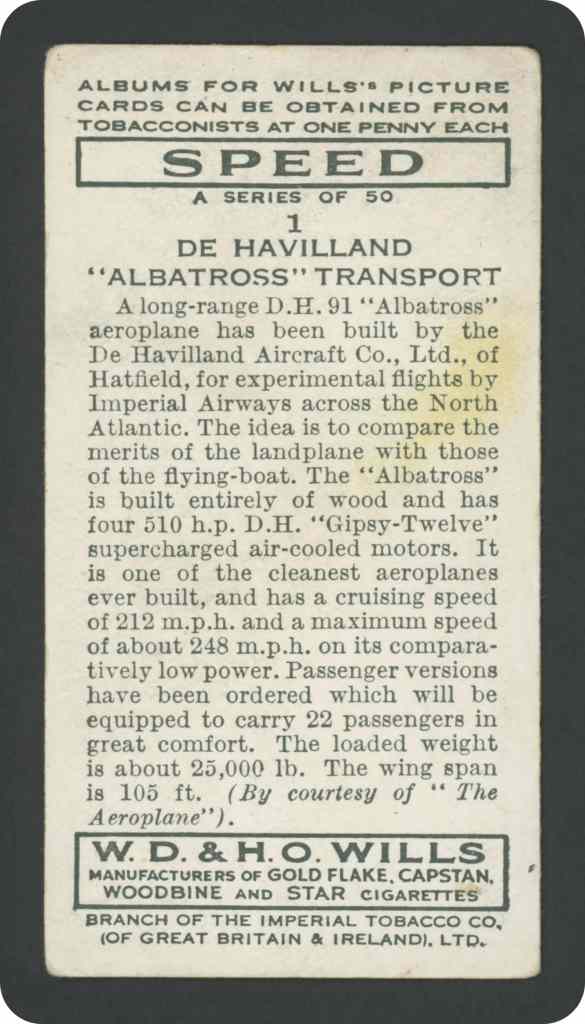
Armstrong Whitworth “Ensign” Transport
Fourteen A. W. “Ensign’ 40-pas-senger transport aeroplanes are being built by Sir W. G. Armstrong Whitworth Aircraft, Ltd., for operation over certain sections of Imperial Airways Empire air lines. Each has four 880 h.p. Armstrong Siddeley “Tiger” IX motors giving a cruising speed of about 170 m.p.h. and a range of 760 miles; the maximum speed is slightly more than 200 m.p.h. The A.W. “Ensigns” are at present the largest British land-planes. The normal loaded weight is 46,500 lb. (21 tons) and they have wing spans of 123 ft. The undercarriage retracts a distance of 14 ft. into the high wing. The passenger accommodation is divided into four separate cabins. (By courtesy of “The Aeroplane”).
No Variations
No Error Cards Reported
3
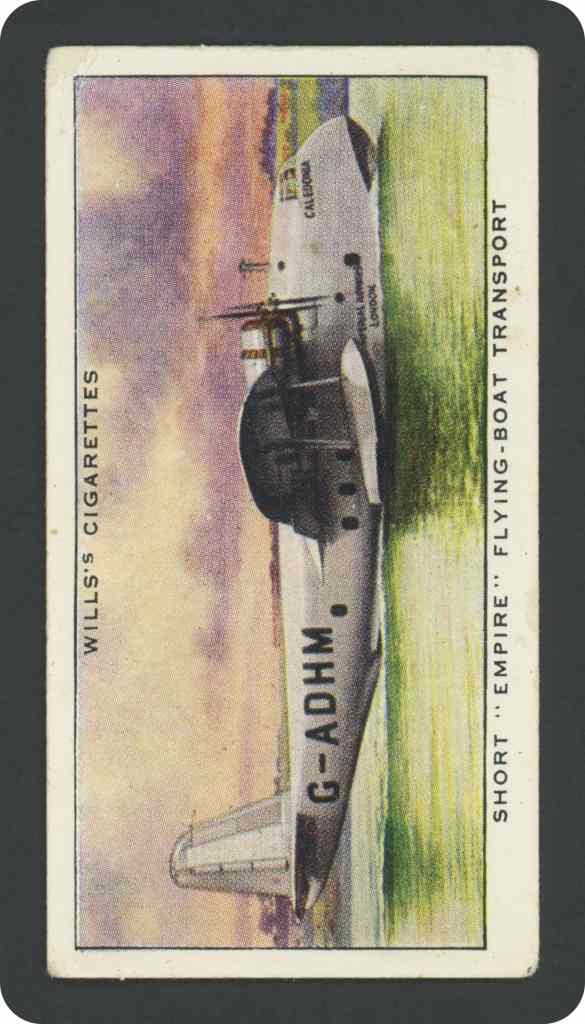
Short “Empire” Flying-Boat Transport
Built by Short Bros., Ltd., of Rochester, for tImperial Airways, the Short powered with four 910 h.p. Bristol “Pegasus” X.C. radial air-cooled motors, can carry 24 passengers and 14 tons of mail for a normal range of 810 miles at a cruising speed of 165 m.p.h. The Caledonia and the Cam-bria, special versions of the standard boats with a range of 3,300 miles, made five double-crossings of the North Atlantic, without incident. during the summer of 1937. These boats were loaded to a maximum weight of 45,000 lb. (20 tons), 4,500Ib. more than the standard boats. Imperial Airways have 28 standard “Empire” flying-boats operating between England and Australia and England a South Africa. (By courtesy of “The Aeroplane”).
No Variations
No Error Cards Reported

4
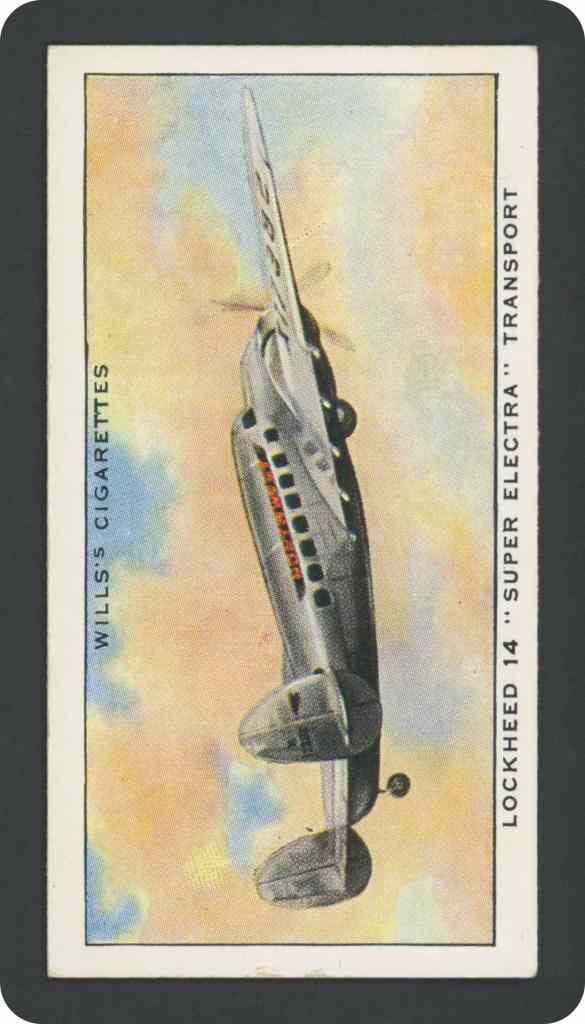
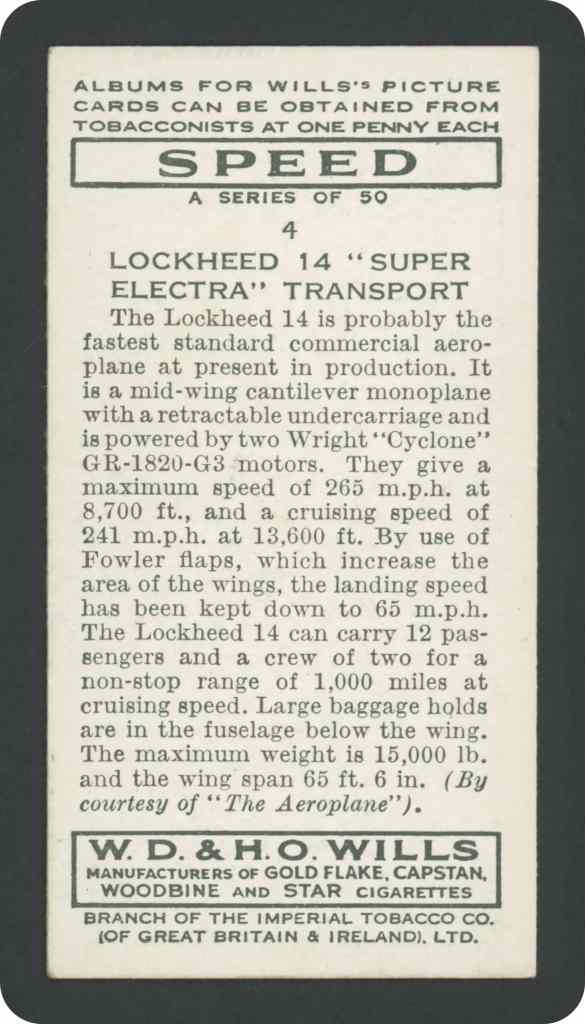
Lockheed 14 “Super Electra” Transport
The Lockheed 14 is probably the fastest standard commercial aero-plane at present in production. It is a mid-wing cantilever monoplane with a retractable undercarriage and is powered by two Wright “Cyclone” GR-1820-G3 motors. They give a maximum speed of 265 m.ph. at 8,700 ft., and a cruising speed of 241 m.p.h. at 13,600 ft. By use of Fowler flaps, which increase the area of the wings, the landing speed has been kept down to 65 m.p.h. The Lockheed 14 can carry 12 passengers and a crew of two for a non-stop range of 1,000 miles at cruising speed. Large baggage holds are in the fuselage below the wing. The maximum weight is 15,000 lb. and the wing span 65 ft. 6 in. (By courtesy of ” The Aeroplane”).
No Variations
No Error Cards Reported
5
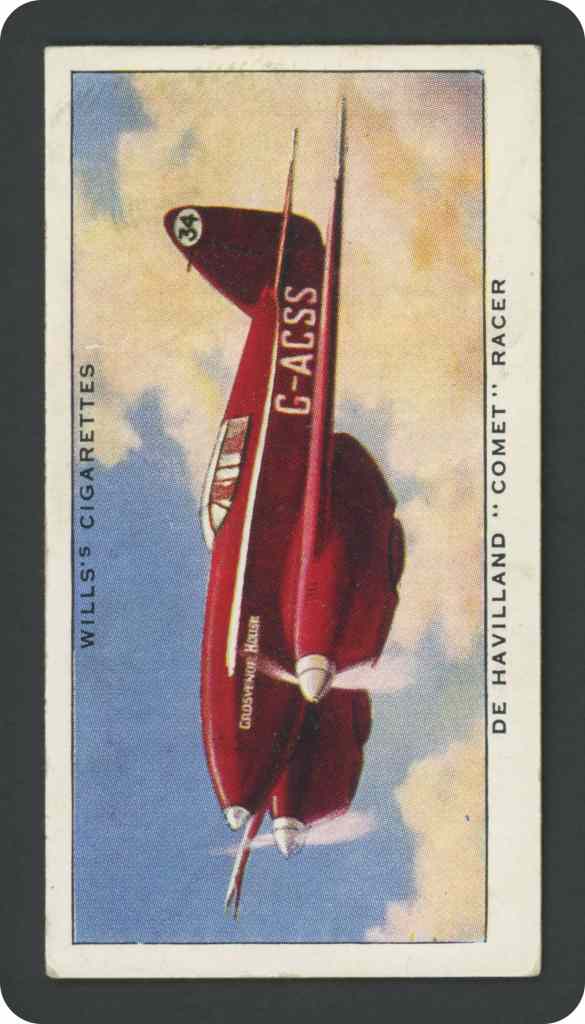
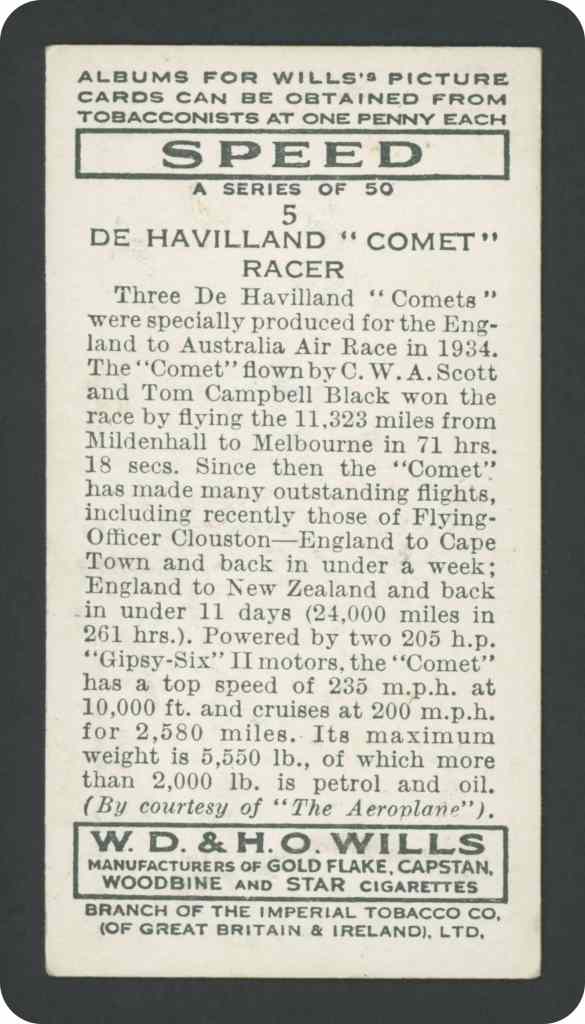
De Havilland “Comet” Racer
Three De Havilland ” Comets” were specially produced for the England to Australia Air Race in 1934. The “Comet” flown by C. W. A. Scott and Tom Campbell Black won the race by flying the 11,323 miles from Mildenhall to Melbourne in 71 hrs. 18 secs. Since then the “Comet’ has made many outstanding flights, including recently those of Flying-Officer Clouston- -England to Cape Town and back in under a week: England to New Zealand and back .in under 11 days (21,000 miles in 261 hrs.). Powered by two 205 h.p. “Gipsy-Six’ Il motors, the “Comet” has a top speed of 235 m.p.h. at 10,000 ft. and cruises at 200 m.p.h. for 2,580 miles. Its maximum weight is 5,550 Ib., , of which more than 2,000 lb. is petrol and oil. (By courtesy of “The Aeroplane”).
No Variations
No Error Cards Reported
6
Percival Mew “Gull” III Racer
For several years the fastest time in the King’s Cup Air Race has been put up by Mr. Edgar Percival flving a “Mew Gull.” In 1937 Mr. Charles Gardner won at an average speed of 233•7 m.p.h. flying a Percival “Mew Gull,” and Mr. Percival was third in a similar machine. The latest version, powered with a 205h.p. “Gipsy-Six” II motor, has a top speed of more than 235 m.p.h. and the machine can cruise for 810 miles at 200 m.p.h. “Mew Gulls” are built of wood with plywood covering. They are low-wing cantilever monoplanes with fixed spatted undercarriages of very low drag. In spite of theirspeed, these ‘planes are easy to manœuvre; the pilot sits in a closed cockpit. The total loaded weight is 2,125 lb. (By courtesy of ” The Aeroplane*).
No Variations
No Error Cards Reported


7
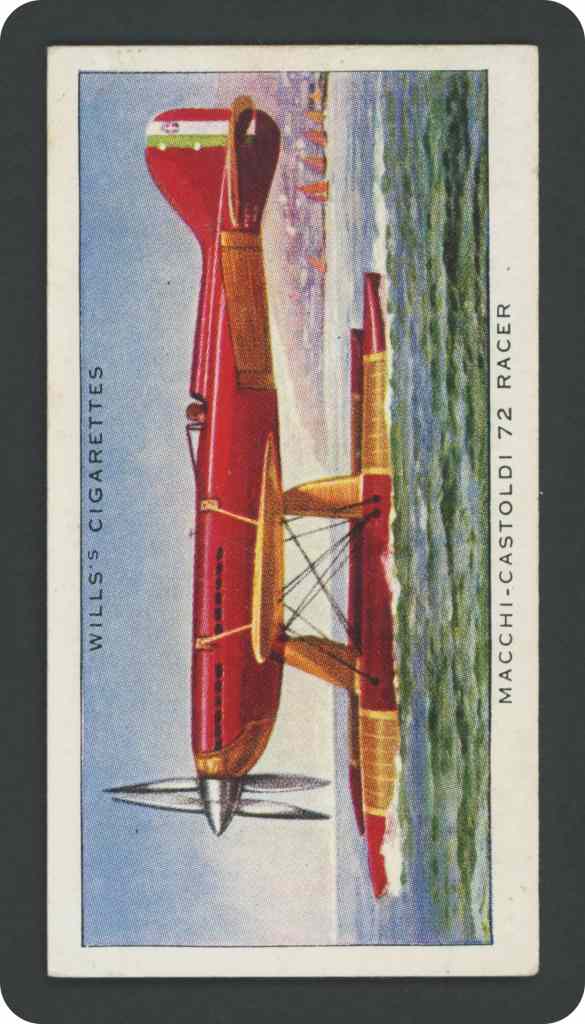
Macchi-Castodi 72 Racer
Italy still holds the World absolute speed record, which was set up on Oct. 23rd, 1934, when Lieut. Agello covered a 3 km. course in two directions at an average speed of 440•67 m.ph. The machine was the Macchi-Castoldi M.C. 72 float seaplane, powered by a Fiat A.S.6 24-cylinder liquid-cooled motor boosted to give 3,100 h.p. It drove two airscrews on concentric shafts in opposite directions, one in front of the other. The seaplane was originally built for the 1931 Schneider Trophy Contest, but was not ready at that time. The loaded weight was about 8,000 lb. and the wing span about 35 ft. The speed record has stood for nearly four years but there are signs that it will be broken before very long. (By courtesy of “The Aeroplane”).
No Variations
No Error Cards Reported
8
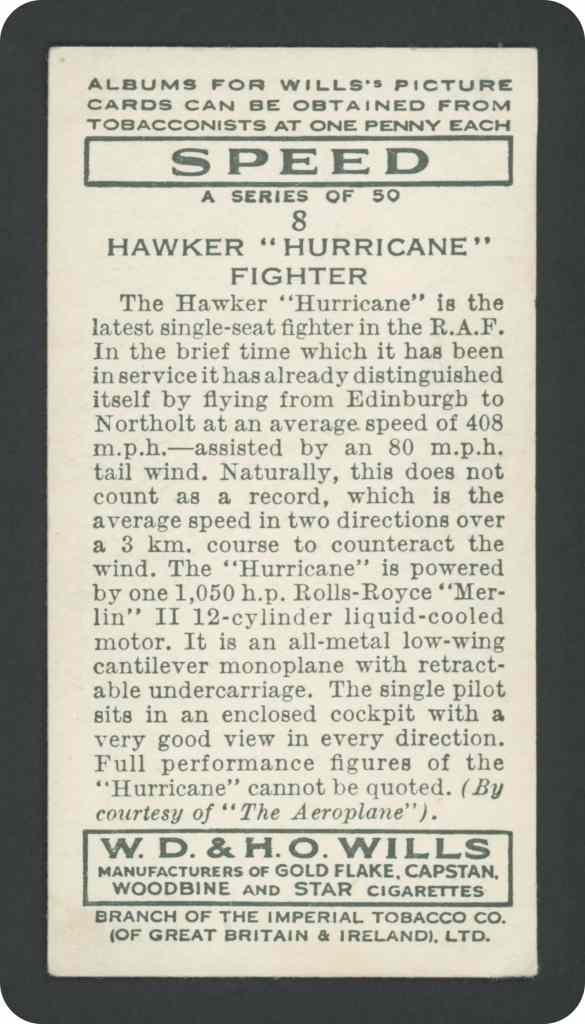
Hawker “Hurricane” Fighter
The Hawker “Hurricane” is the latest single-seat fighter in the R.A.F. In the brief time which it has been in service it has already distinguished itself by flying from Edinburgh to Northolt at an average. speed o£ 408 m.p.h. -assisted by an 80 m.p.h. tail wind. Naturally, this does not count as a record, which is the average speed in two directions over a 3 km. course to counteract the wind. The “Hurricane” is powered by one 1,050 h.p. Rolls-Royce “*Mer-lin” II 12-cylinder liquid-cooled motor. It is an all-metal low-wing cantilever monoplane with retractable undercarriage. The single pilot sits in an enclosed cockpit with a very good view in every direction. Full performance figures of the “Hurricane” cannot be quoted. ( By courtesy of “The Aeroplane”).
No Variations
No Error Cards Reported

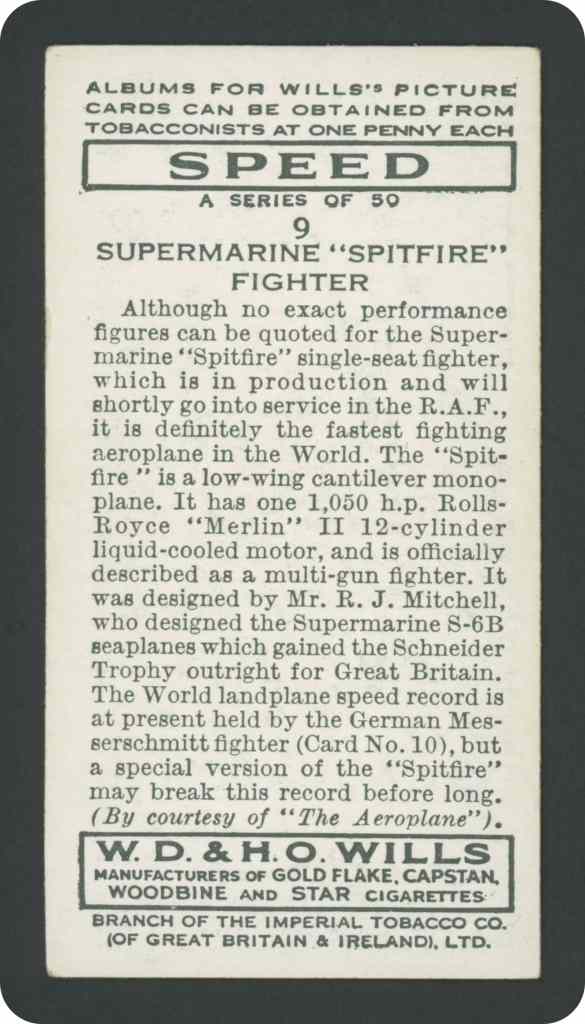
9
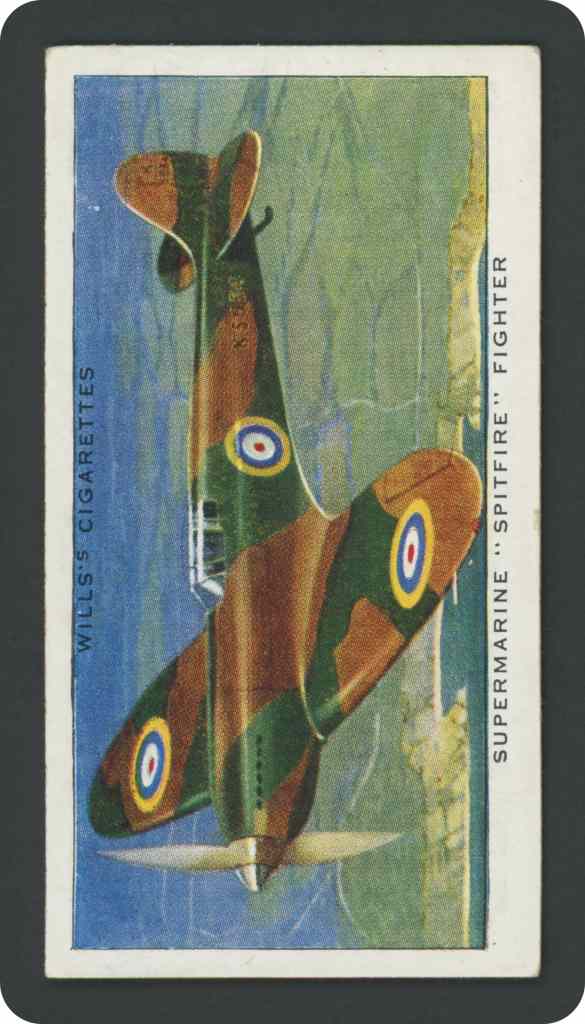
Supermarine “Spitfire” Fighter
Although no exact performance figures can be quoted for the Super-marine “Spitfire” single-seat fighter, which is in production and will shortly go into service in the R.A.F., it is definitely the fastest fighting aeroplane in the World. The “Spit- fire” is a low-wing cantilever mono-plane. It has one 1,050 h.p. Rolls-Royce “Merlin’ II 12-cylinder liquid-cooled motor, and is officially described as a multi-gun fighter. It was designed by Mr. R. J. Mitchell, who designed the Supermarine S-6B seaplanes which gained the Schneider Trophy outright for Great Britain. The World landplane speed record is at present held by the German Messerschmitt fighter (Card No. 10), but a special version of the “Spitfire” may break this record before long. (By courtesy of “The Aeroplane”).
No Variations
No Error Cards Reported
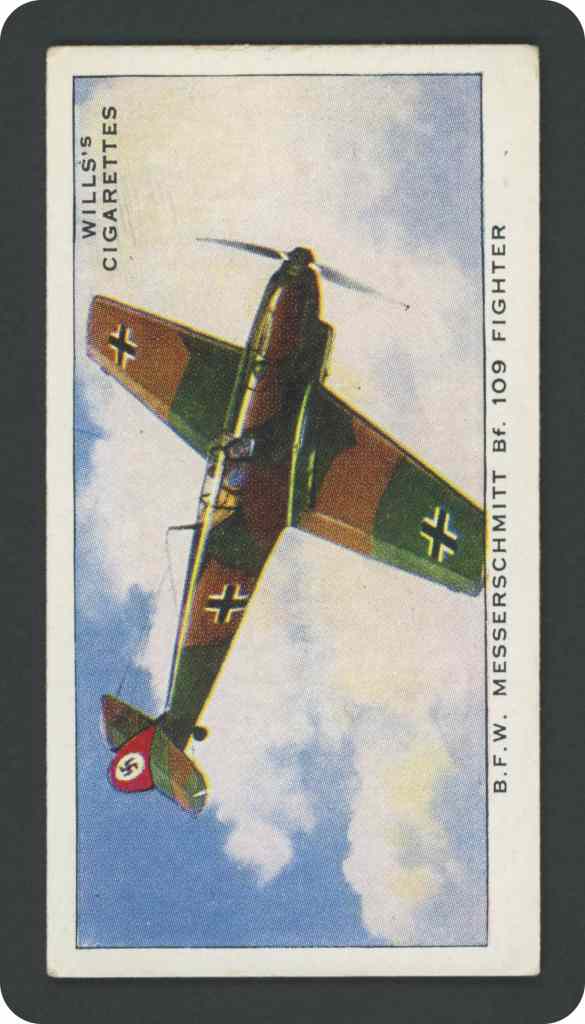
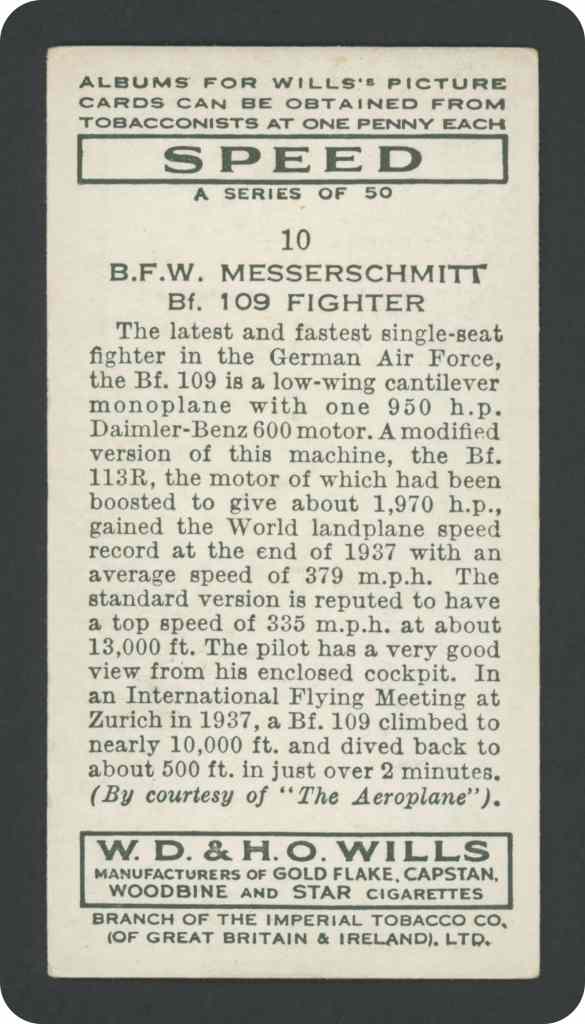
10
B.F.W. Messerschmitt Bf. 109 Fighter
The latest and fastest single-seat fighter in the German Air Force, the Bf. 109 is a low-wing cantilever monoplane with one 950 h.p. Daimler- Benz 600 motor. A modified version of this machine, the Bf. 113R, the motor of which had been boosted to give about 1,970 h.p., gained the World landplane speed record at the end of 1937 with an average speed of 379 m.ph. The standard version is reputed to have a top speed of 335 m.p.h. at about 13,000 ft. The pilot has a very good view from his enclosed cockpit. In an International Flying Meeting at Zurich in 1937, a Bf. 109 climbed to nearly 10,000 ft. and dived back to about 500 ft. in just over 2 minutes. (By courtesy of “The Aeroplane”).
No Variations
No Error Cards Reported
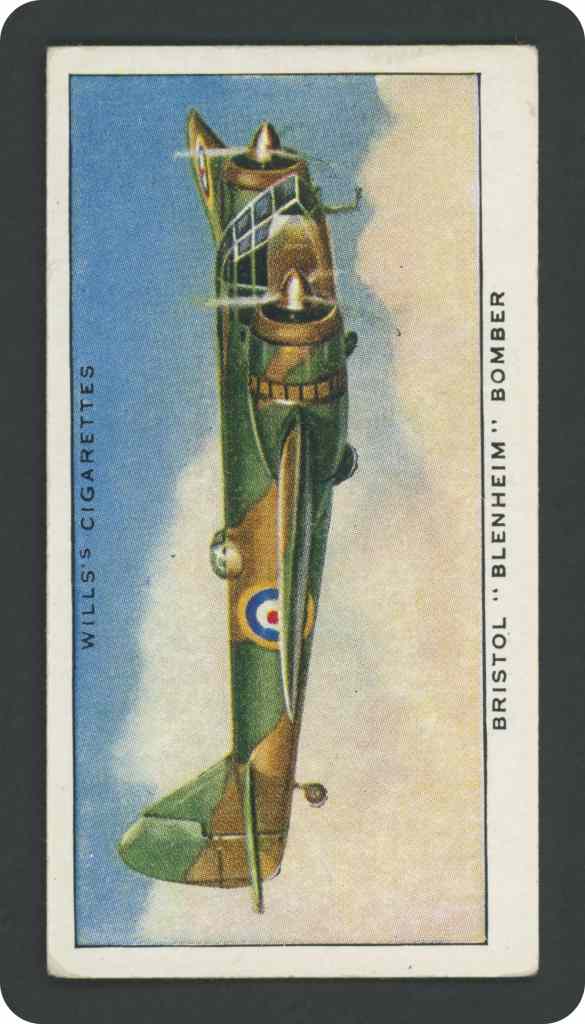
11
Bristol “Blenheim” Bomber
Produced in large quantities for the R.A.F., the Bristol “Blenheim’ is the World’s fastest bomber. With two 840h.p. “Mercury” VIII motors, the “Blenheim” has an official top-speed of 279 m.ph. at 15,000 ft. with full load. It can cruise for 1,000 miles at 220 m.p.h. with 4,621 lb. of fuel and bombs, and when lightly loaded is said to have done wellover 300 m.p.h. The “Blenheim” is an example of the modern trend towards mid-wing monoplanes for higher efficiency. It is of all-metal construction with a retractable undercarriage, split flaps and three-blade controllable-pitch airscrews. There is a crew of three, pilot, bomb-aimer and gunner. The maximum loaded weight is 12,030 lb. and the wing span 56 ft. 4 in. (By courtesy of “The Aeroplane”).
No Variations
No Error Cards Reported
12
Boeing B-17 Bomber
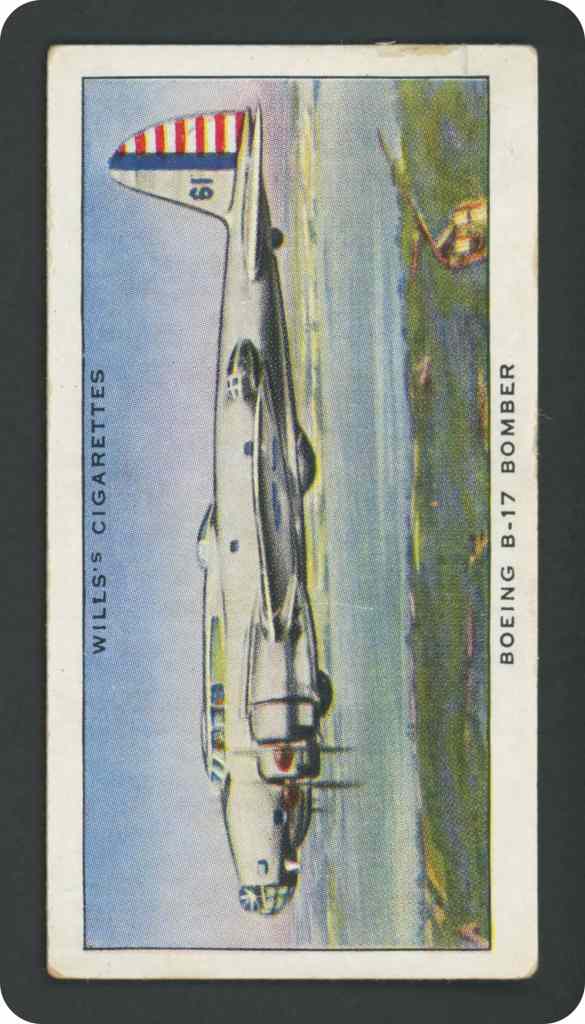
America has developed the large four-motor high-speed bomber to a greater extent than any other nation. The Boeing B-17, powered by four 1,000 h.p. Wright ” Cyclone ” G 9-cylinder radial air-cooled motors, can carry a crew of nine and several thousand pounds of bombs for more than 2,000 miles at a cruising speed of well over 200 m.p.h.; maximum speed is said to be more than 250 m.ph. The machine is an all-metal “mid-wing cantilever monoplane. The undercarriage retracts upwards into the motor nacelles. There are five machine-gun positions, one in a nose gun-turret and four others in streamline blisters on the sides, top and bottom of the fuselage. The wing span is 105 ft. and the all-up loaded weight is about 45,000 lb. (By courtesy of “The Aeroplane”).
No Variations
No Error Cards Reported
13
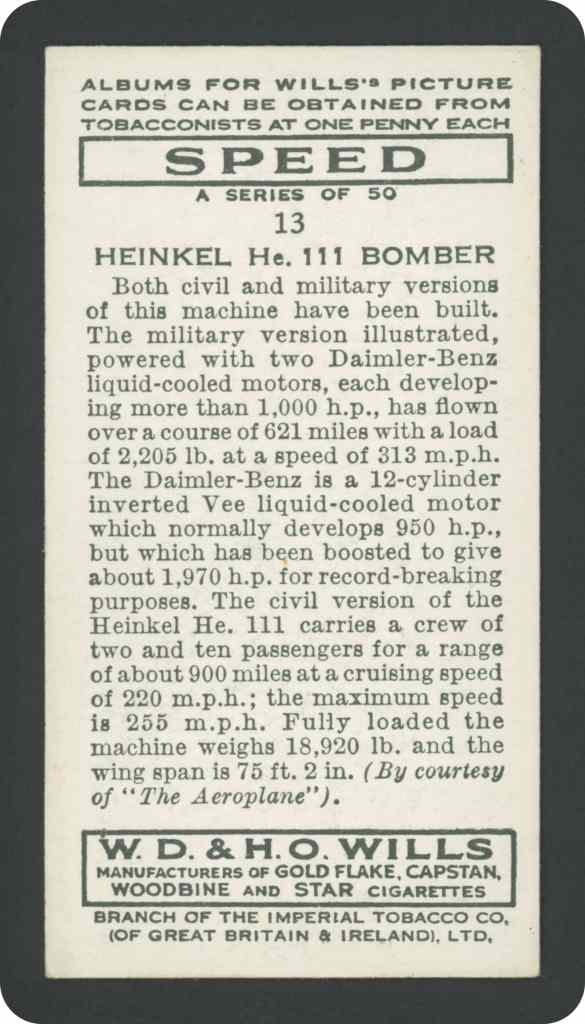
Heinkel He. 111 Bomber
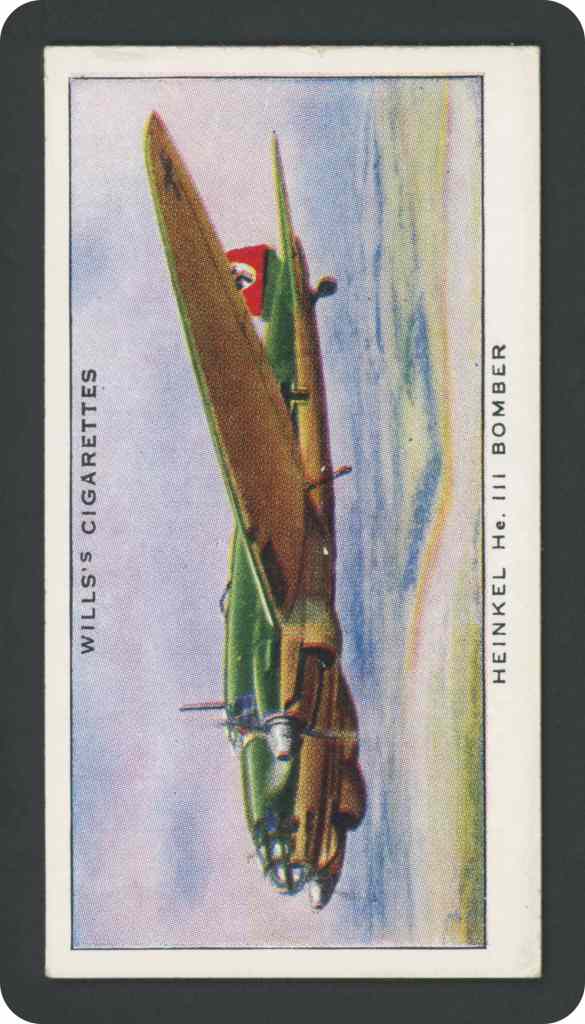
Both civil and military versions of this machine have been built. The military version illustrated, powered with two Daimler- Benz liquid-cooled motors, each developing more than 1,000 h.., has flown over a course of 621 miles with a load of 2,205 lb. at a speed of 313 m.p.h. The Daimler-Benz is a 12-cylinder inverted Vee liquid-cooled motor which normally develops 950 h.p., but which has been boosted to give about 1,970 h.p. for record-breaking purposes. The civil version of the Heinkel He. 111 carries a crew of two and ten passengers for a range of about 900 miles at a cruising speed of 220 m.p.h.; the maximum speed is 255 m.ph. Fully loaded the machine weighs 18,920 lb. and the wing span is 75 ft. 2 in. (By courtesy of “The Aeroplane”).
No Variations
No Error Cards Reported
14
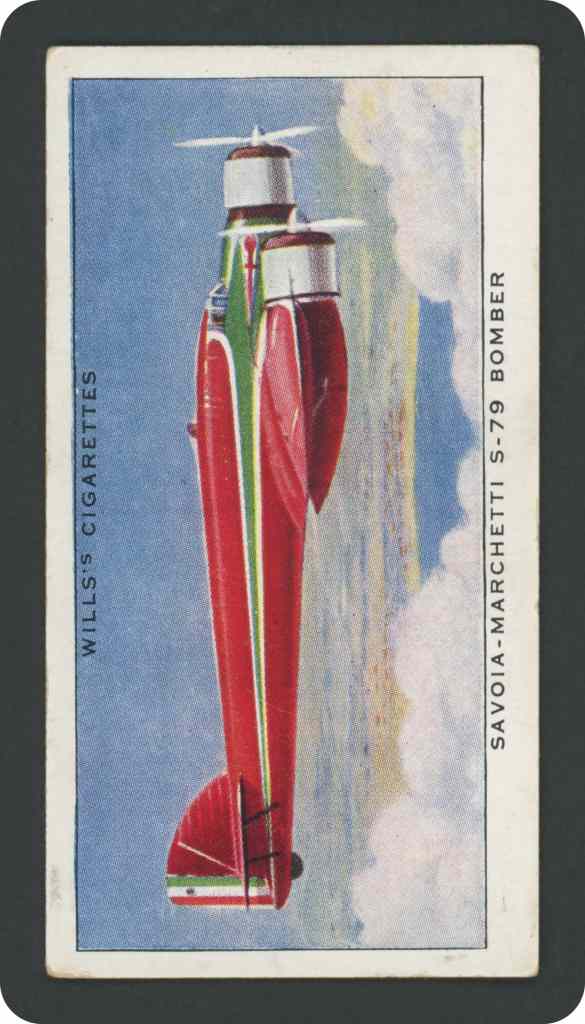
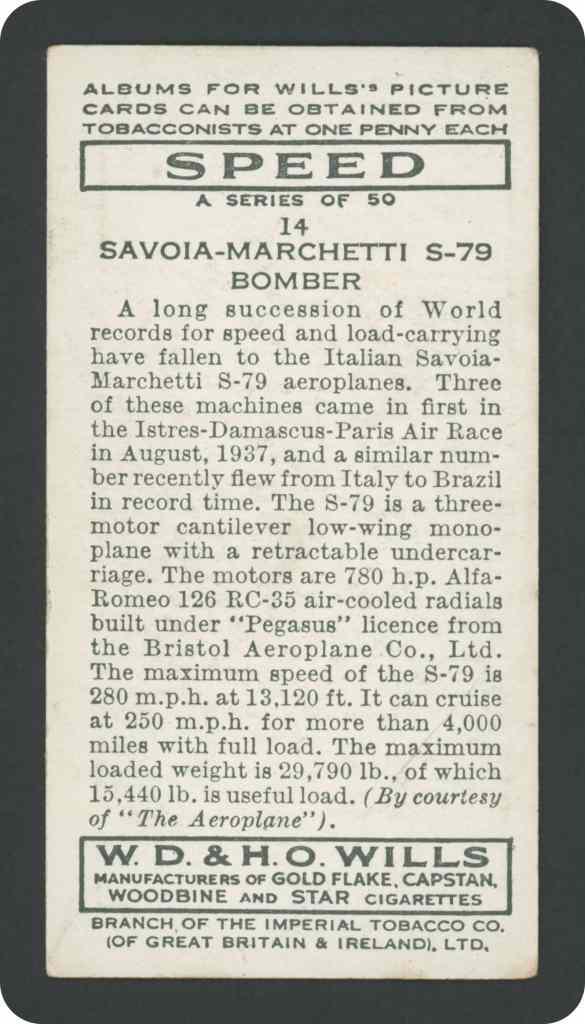
Savoia-Marchetti S-79 Bomber
A long succession of World records for speed and load-carrying have fallen to the Italian Savoia-Marchetti S-79 aeroplanes. Three of these machines came in first in the Istres-Damascus-Paris Air Race in August, 1937, and a similar number recently flew from Italy to Brazil in record time. The S-79 is a three-motor cantilever low-wing monoplane with a retractable undercar- riage. The motors are 780 h.p. Alfa-Romeo 126 RC-35 air-cooled radials built under “Pegasus” licence from the Bristol Aeroplane Co., Ltd. The maximum speed of the S-79 ig 280 m.p.h. at 13,120 ft. It can cruise at 250 m.p.h. for more than 4,000 miles with full load. The maximum loaded weight is 29,790 lb., of which 15,440 Ib. is useful load. ( By courtesy of “The Aeroplane”).
No Variations
No Error Cards Reported
15
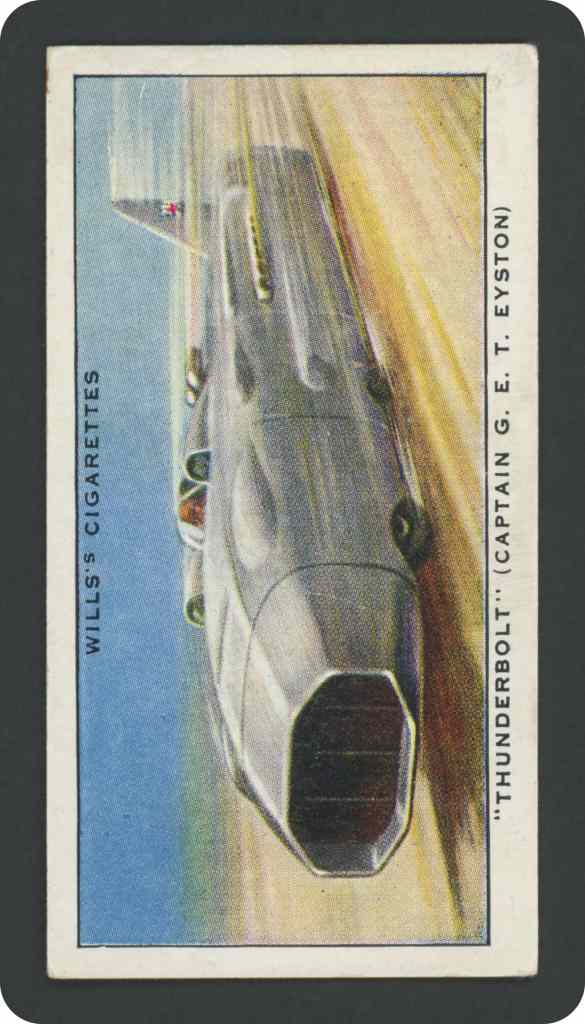
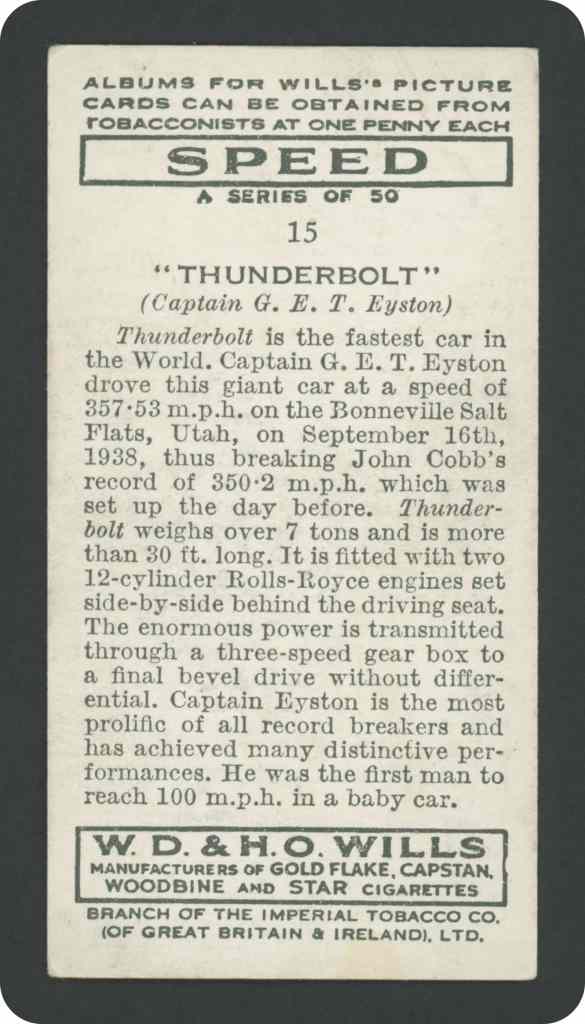
Thunderbolt
Thunderbolt is the fastest car in the World. Captain G. E. T. Eyston drove this giant car at a speed of 357:53 m.p.h. on the Bonneville Salt Flats, Utah, on September 16th, 1938, thus breaking John Cobb’s record of 350•2 m.ph. which was set up the day before. Thunderbolt weighs over 7 tons and is more than 30 ft. long. It is fitted with two 12-cylinder Rolls-Royce engines set side-by-side behind the driving seat. The enormous power is transmitted through a three-speed gear box to a final bevel drive without differ-ential. Captain Eyston is the most prolific of all record breakers and has achieved many distinctive per- formances. He was the first man to reach 100 m.p.h. in a baby car.
No Variations
No Error Cards Reported
16
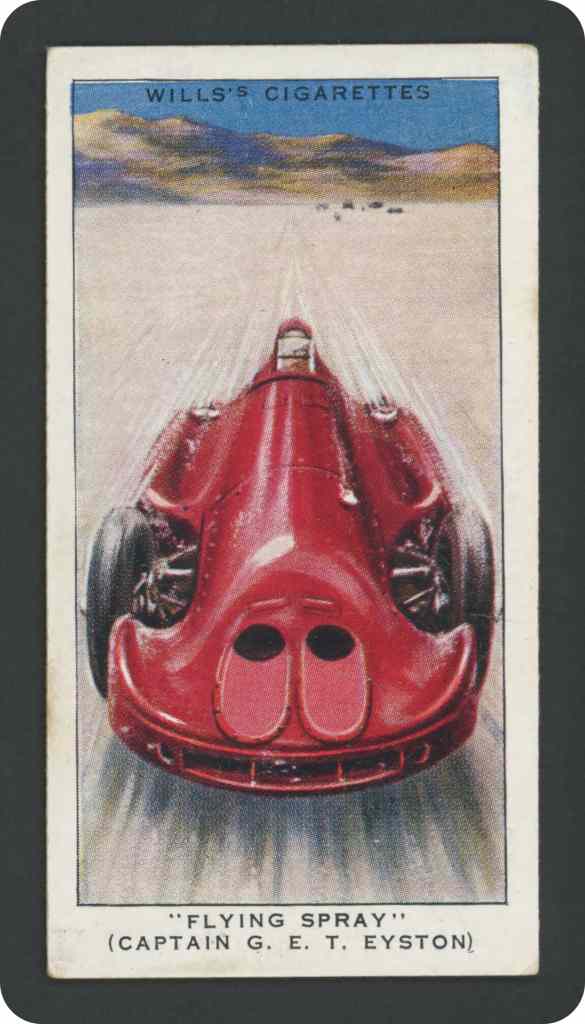
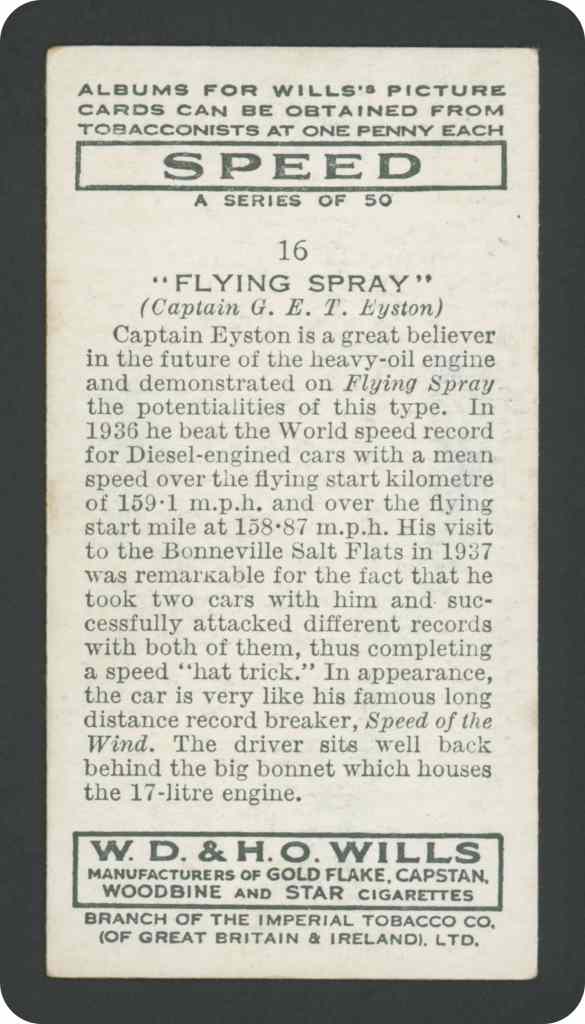
Flying Spray
Captain Eyston is a great believer in the future of the heavy-oil engine and demonstrated on Flying Spray the potentialities of this type. In 1936 he beat the World speed record for Diesel-engined cars with a mean speed over the flying start kilometre of 1591 m.p.h. and over the flying start mile at 158•87 m.ph. His visit to the Bonneville Salt Flats in 1937 was remarkable for the fact that he took two cars with him and successfully attacked different records with both of them, thus completing a speed “hat trick.” In appearance, the car is very like his famous long distance record breaker, Speed of the Wind. The driver sits well back behind the big bonnet which houses the 17-litre engine.
No Variations
No Error Cards Reported
17
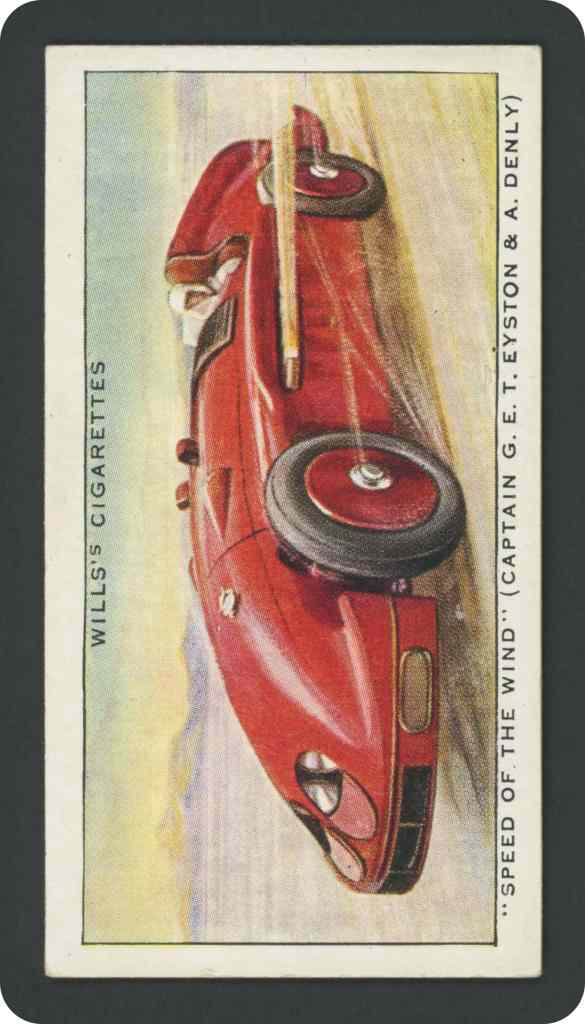
Speed Of The Wind
Speed of the Wind, unconven-tionally-designed car equipped with Rolls-Royce engine, has covered more miles in one round of the clock than any other. Manned by Captain Eyston and A. Denly, it achieved a distance of 1,964 miles at an average speed of 163:68 m.ph. on the Bonneville Salt Flats, Utah, although the track was soggy after an unusually rainy season. As the car sped round on the glistening salt, the track became softer and softer and driving became more difficult, but the two intrepid drivers carried on till the record was won. Speed of the Wind is now locked in a garage by the side of the Salt Lake ready for Eyston to make another attempt on long distance records.
No Variations
No Error Cards Reported
18
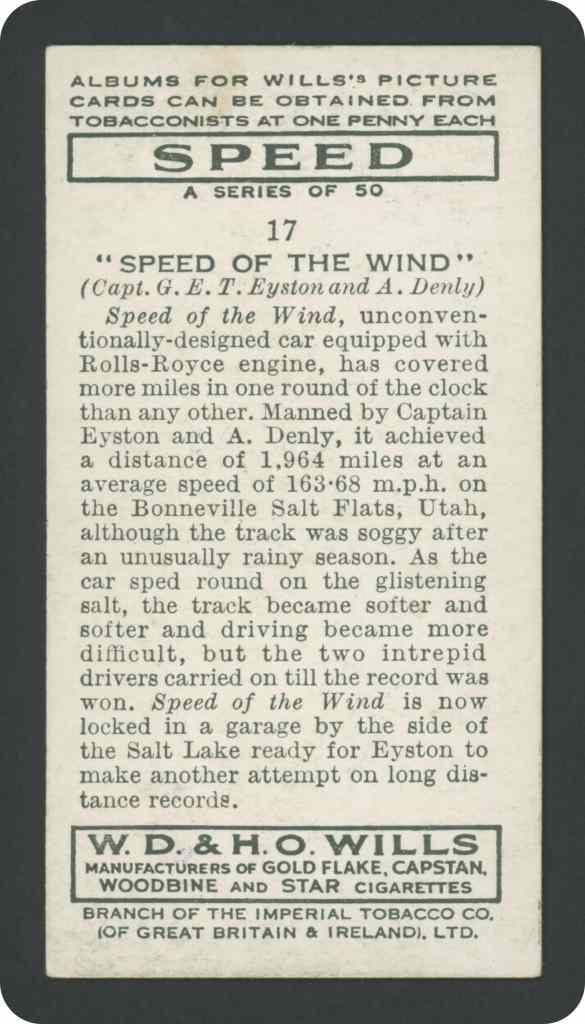
Mormon Meteor
During a 24-hours run on the Bonneville Salt Flats, Utah, Mormon Meteor, driven by the American, Ab Jenkins, averaged 157•27 m.p.h. thus beating 14 World long distance records and 115 class records. The car is equipped with a 12-cylinder air- cooled engine of 725 hp. and weighs 2 tons. Streamlining is obtained by cowling, but apart from the tiny cowl in front of the driver’s face, there is very little protection and Jenkins has to wear a very tight-fitting helmet to prevent the wind “clawing.” Ab Jenkins is credited with very valuable knowledge of the dried-up lake at Bonneville, now regarded as the World’s premier speed track. He is usually on the spot to challenge any British driver who essays to beat his long-distance records.
No Variations
No Error Cards Reported

19
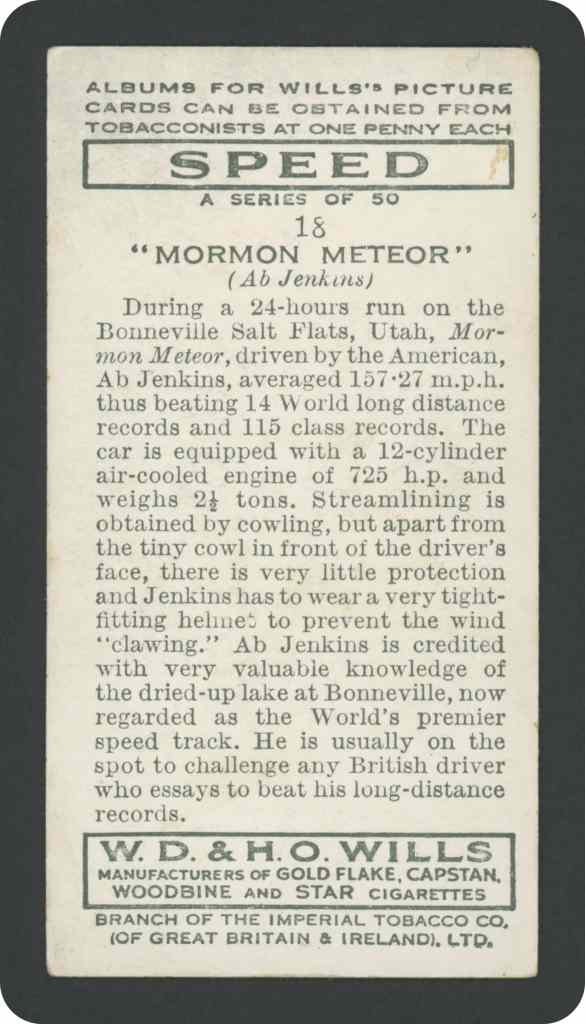
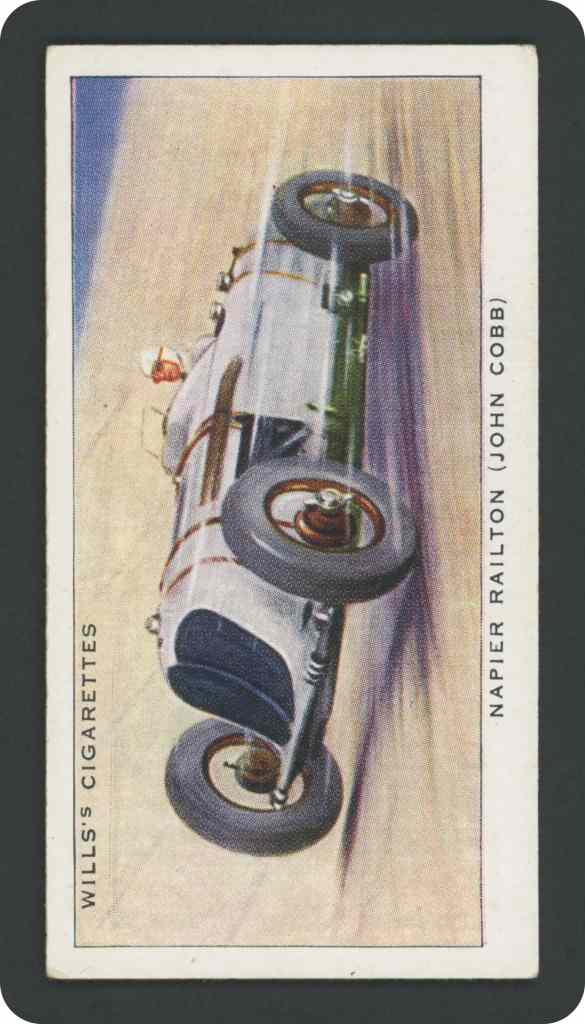
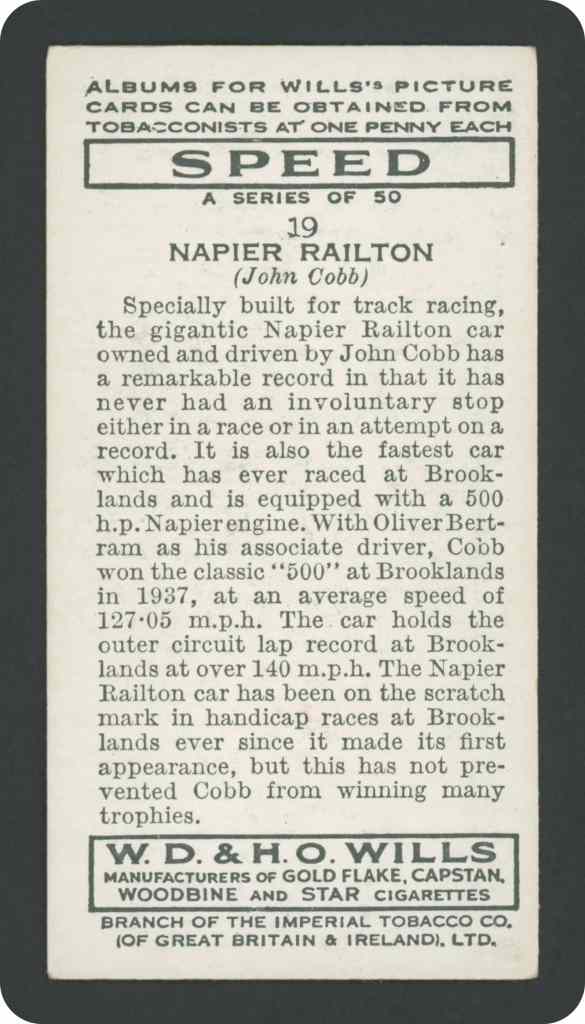
Napier Railton
Specially built for track racing, the gigantic Napier Railton car owned and driven by John Cobb has a remarkable record in that it has never had an involuntary stop either in a race or in an attempt on a record. It is also the fastest car which has ever raced at Brook-lands and is equipped with a 500 h.p. Napierengine. With Oliver Bertram as his associate driver, Coob won the classic “500”‘ at Brooklands in 1937, at an average speed of 127.05 m.ph. The car holds the outer circuit lap record at Brook-lands at over 140 m.p.h. The Napier Railton car has been on the scratch mark in handicap races at Brook-lands ever since it made its first appearance, but this has not prevented Cobb from winning many trophies.
No Variations
No Error Cards Reported
20
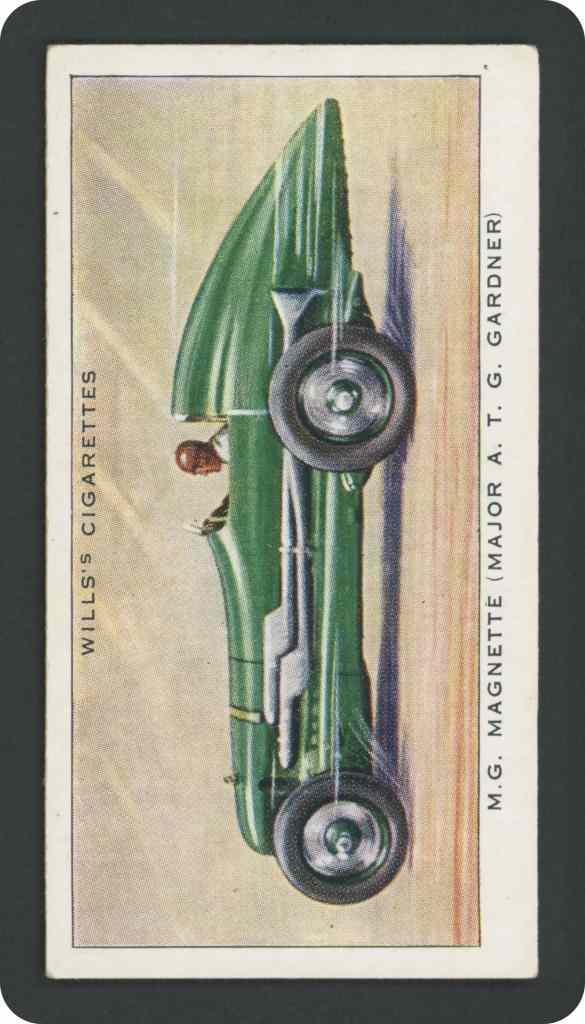
M.G. Magnette
Major “Goldie” Gardner is one of the most popular and versatile of our racing drivers. In spite of the handicap of a leg injured as the result of a war wound, he has had a long and successful career in the world of speed. His crowning triumph was achieved on the Frankfurt Autobahn, where he drove the M.G. depicted. Here he succeeded in proving his car to be the fastest light car in the World by achieving a speed of 148•8 m.p.h. Driving the same car, a 1,100 c.c. model, Major Gardner captured a number of International Class G records up to 50 miles, a number of which were established at Montlhèry. His car also holds the outer circuit lap record at Brook-lands for Class G cars.
No Variations
No Error Cards Reported

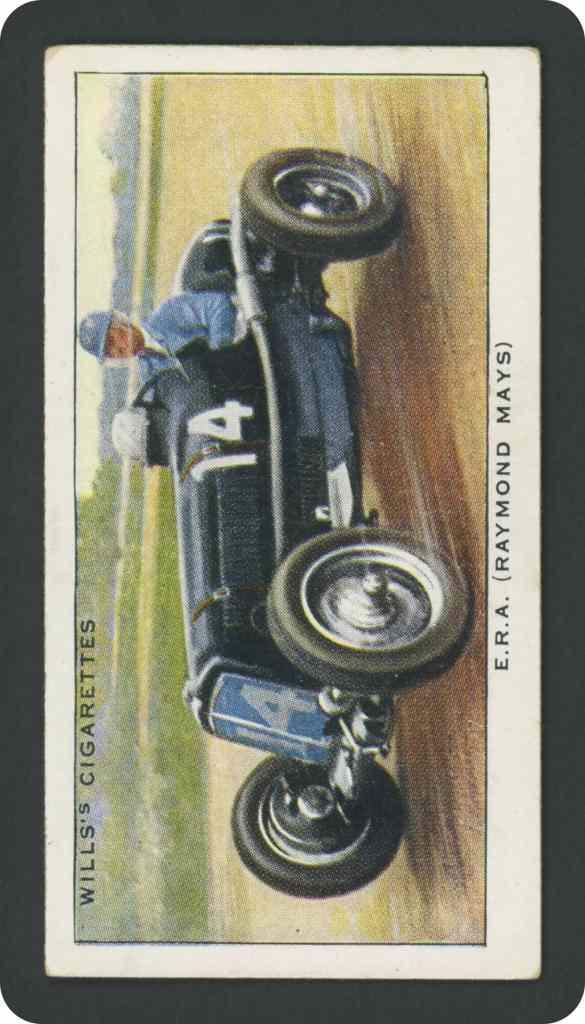
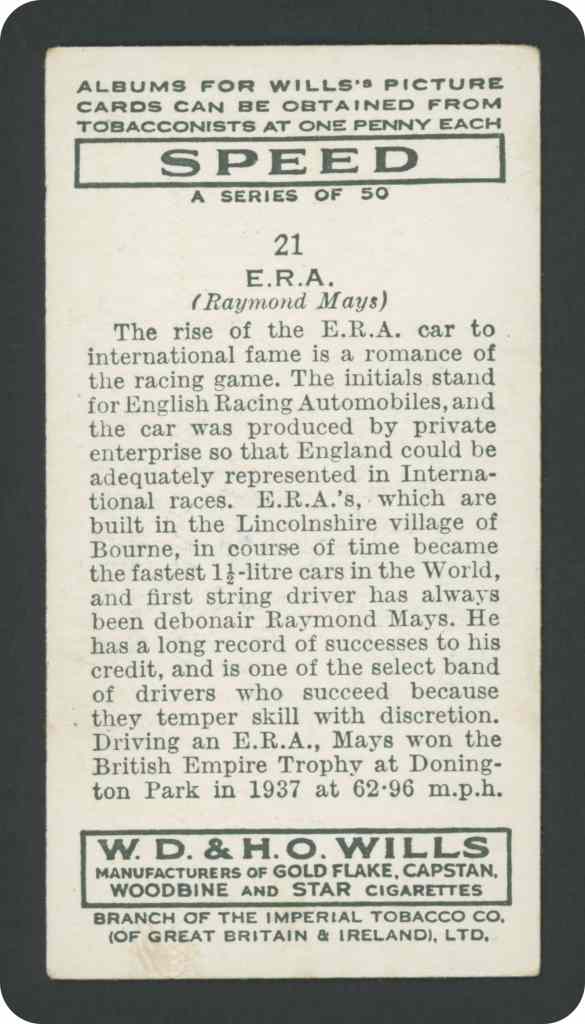
21
E.R.A.
The rise of the E.R.A. car to international fame is a romance of the racing game. The initials stand for English Racing Automobiles, and the car was produced by private enterprise so that England could be adequately represented in International races. E.R.A’s, which are built in the Lincolnshire village of Bourne, in course of time became the fastest 11-litre cars in the World, and first string driver has always been debonair Raymond Mays. He has a long record of successes to his credit, and is one of the select band of drivers who succeed because they temper skill with discretion. Driving an E.R.A., Mays won the British Empire Trophy at Doning-ton Park in 1937 at 62•96 m.p.h.
No Variations
No Error Cards Reported
22
Mercedes-Benz
With the possible exception of Tazio Nuvolari, his great Italian rival, Rudolf Caracciola is the best known of all road racing motorists. For years he has been the accepted “leader of the triumphant German team, whose successful entry into the racing game he initiated by winning the Royal Automobile Club’s Tourist Trophy Race in Northern Ireland, September, 1929. His car, strikingly eloquent of power, with its workmanlike body and 6,000 c.c. engine, has a remarkable record of achievement behind it. In 1937 he won the Italian Grand Prix, averaging the astounding speed of 81•95 m.p.h., and in the same year he won the German and Swiss Grand Prix Races and the German Mountain Championship.
No Variations
No Error Cards Reported
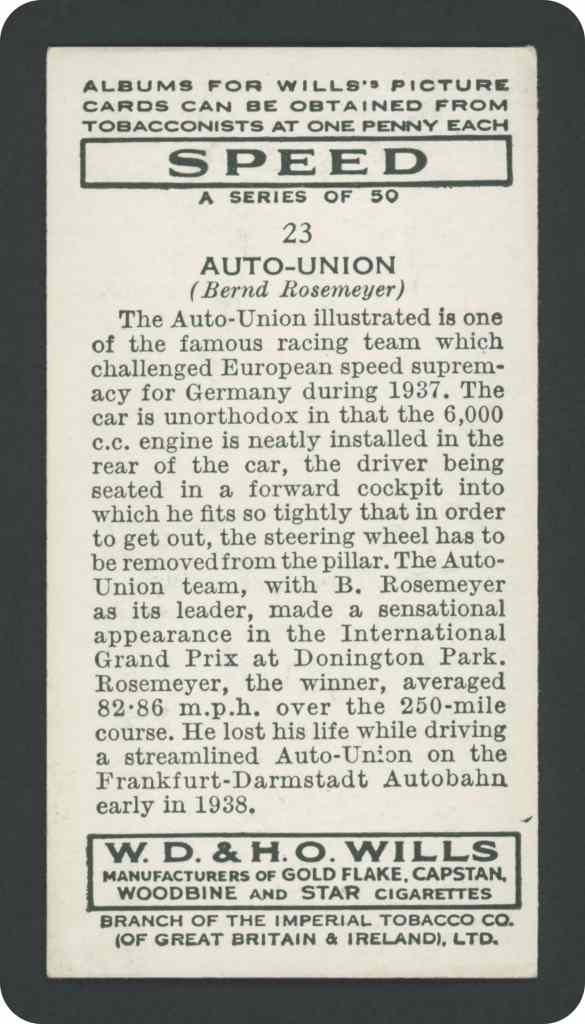
23
Auto-Union
The Auto-Union illustrated is one of the famous racing team which challenged European speed supremacy for Germany during 1937. The car is unorthodox in that the 6,000 c.c. engine is neatly installed in the rear of the car, the driver being seated in a forward cockpit into which he fits so tightly that in order to get out, the steering wheel has to be removed from the pillar. The Auto-Union team, with B. Rosemeyer as its leader, made a sensational appearance in the International Grand Prix at Donington Park. Rosemeyer, the winner, averaged 82•86 m.p.h. over the 250-mile course. He lost his life while driving a streamlined Auto-Union on the Frankfurt-Darmstadt Autobahn early in 1938.
No Variations
No Error Cards Reported

24
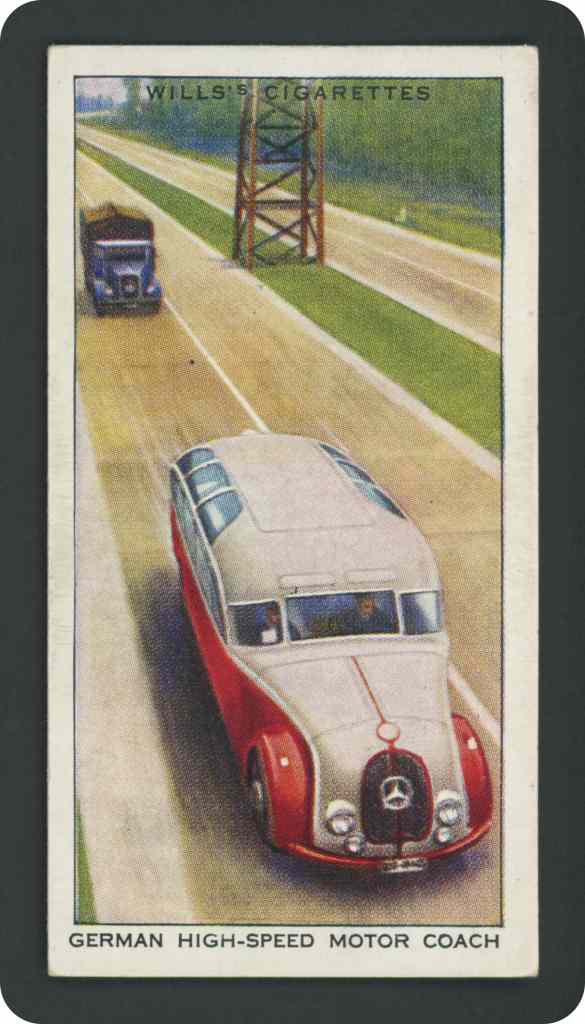
German High-Speed Motor Coach
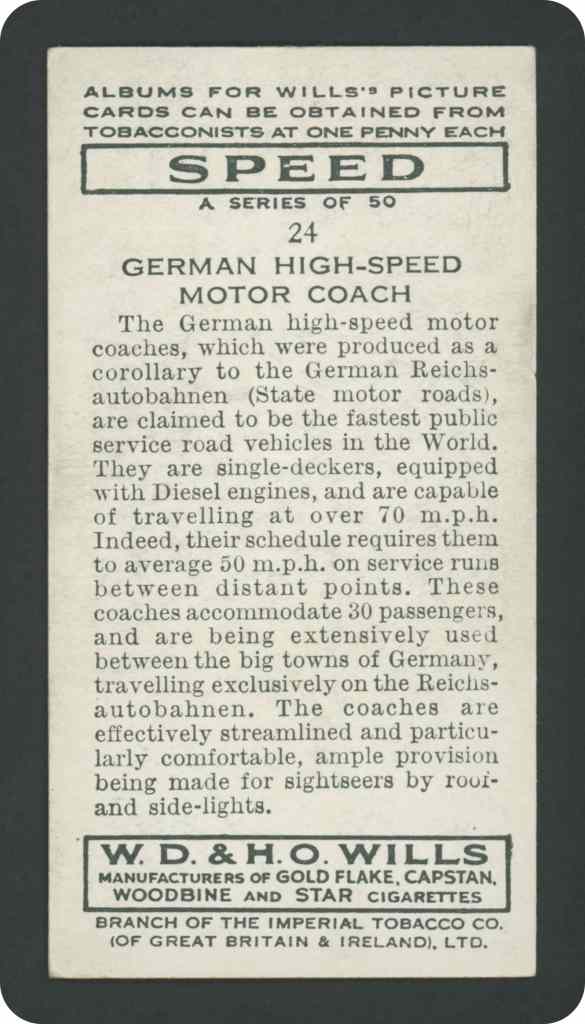
The German high-speed motor coaches, which were produced as a corollary to the German Reichs-autobahnen (State motor roads), are claimed to be the fastest public service road vehicles in the World. They are single-deckers, equipped with Diesel engines, and are capable of travelling at over 70 m.p.h. Indeed, their schedule requires them to average 50 m.p.h. on service runs between distant points. These coaches accommodate 30 passengers, and are being extensively used between the big towns of Germany, travelling exclusively on the Reichs-autobahnen. The coaches are effectively streamlined and particularly comfortable, ample provision being made for sightseers by rovi and side-lights.
No Variations
No Error Cards Reported
25
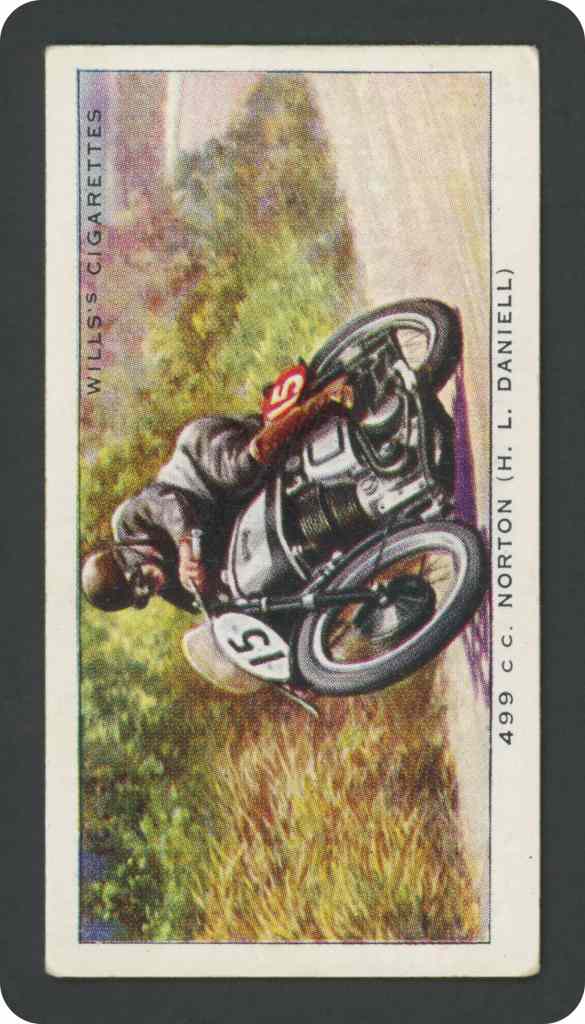
499 C.C. Norton
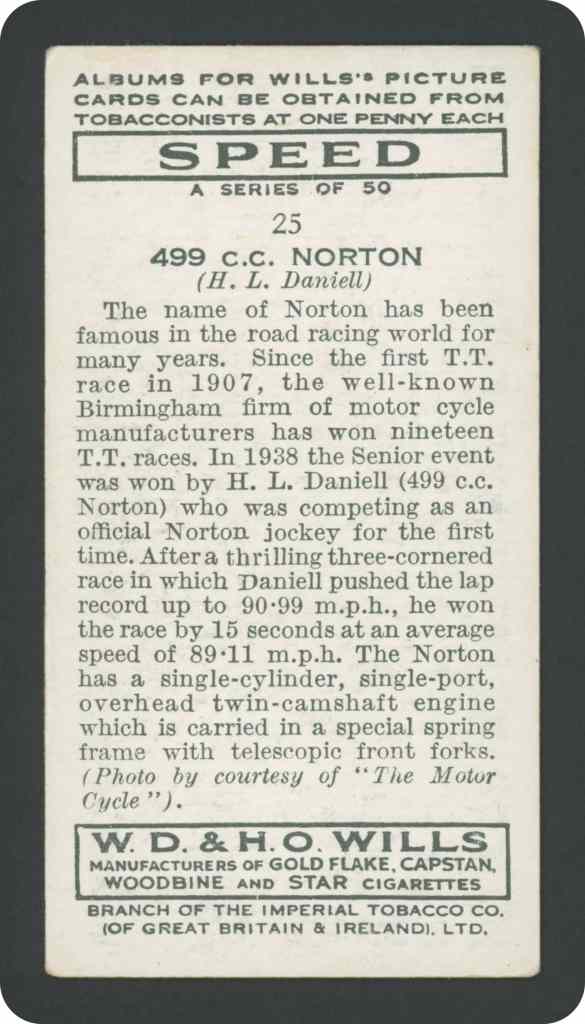
The name of Norton has been famous in the road racing world for many years. Since the first T.T. race in 1907, the well- known Birmingham firm of motor cycle manufacturers has won nineteen T.T. races. In 1938 the Senior event was won by H. L. Daniell (499 c.c. Norton) who was competing as an official Norton jockey for the first time. After a thrilling three-cornered race in which Daniell pushed the lap record up to 90•99 m.ph., he won the race by 15 seconds at an average speed of 89•11 m.ph. The Norton has a single-cylinder, single-port, overhead twin-camshaft engine which is carried in a special spring frame with telescopic front forks. (Photo by courtesy of “The Motor Cycle”).
No Variations
No Error Cards Reported
26
499 C.C. Norton
The name of Norton has been famous in the road racing world for many years. Since the first T.T. race in 1907, the well- known Birmingham firm of motor cycle manufacturers has won nineteen T.T. races. In 1938 the Senior event was won by H. L. Daniell (499 c.c. Norton) who was competing as an official Norton jockey for the first time. After a thrilling three-cornered race in which Daniell pushed the lap record up to 90•99 m.ph., he won the race by 15 seconds at an average speed of 89•11 m.ph. The Norton has a single-cylinder, single-port, overhead twin-camshaft engine which is carried in a special spring frame with telescopic front forks. (Photo by courtesy of “The Motor Cycle”).
No Variations
No Error Cards Reported
27
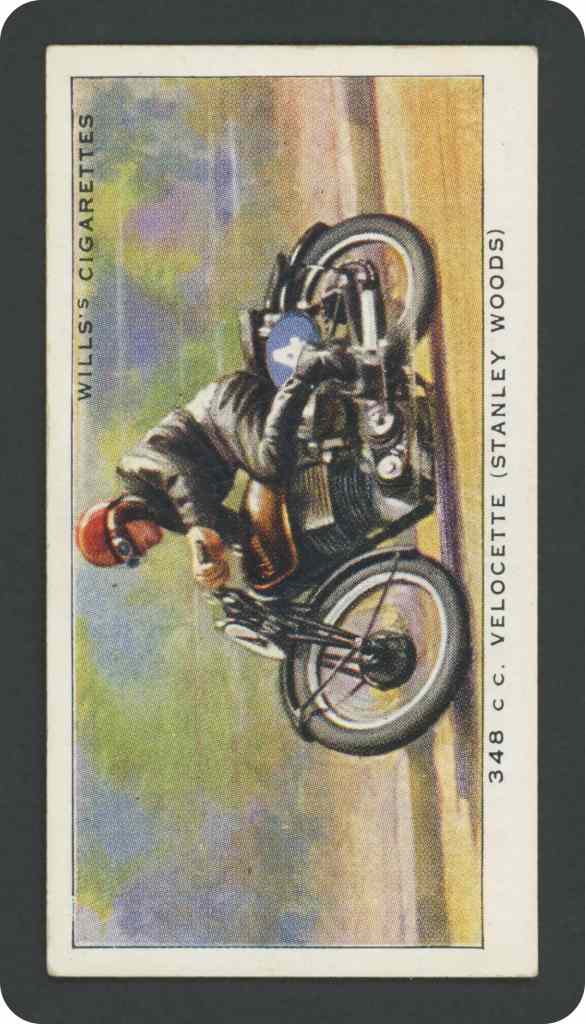
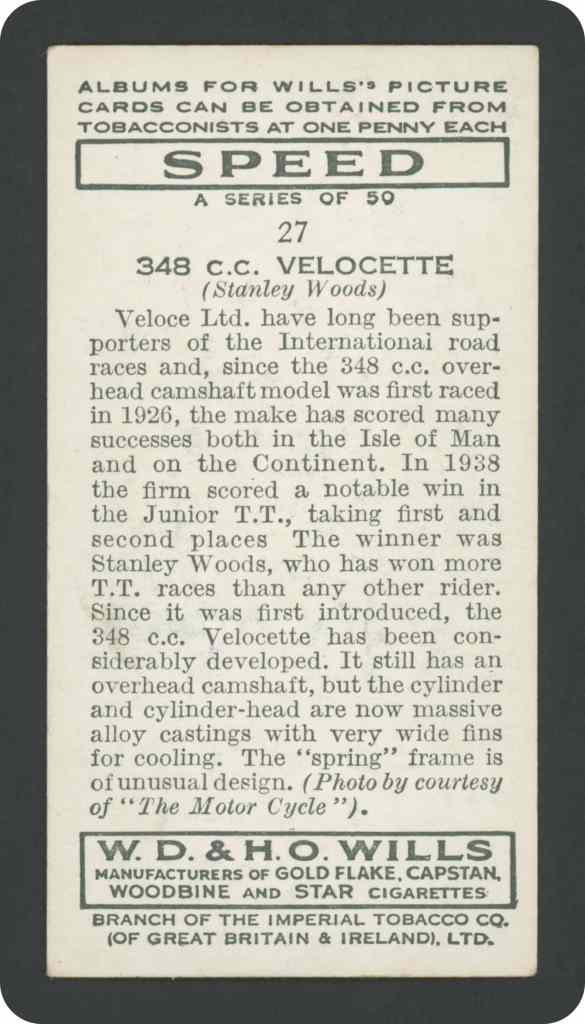
348 C.C. Velocette
Veloce Ltd. have long been supporters of the Internationai road races and, since the 348 c.c. overhead camshaft model was first raced in 1926, the make has scored many successes both in the Isle of Man and on the Continent. In 1938 the firm scored a notable win in the Junior T.T., taking first and second places The winner was Stanley Woods, who has won more T.T. races than any other rider. Since it was first introduced, the 348 c.c. Velocette has been considerably developed. It still has an overhead camshaft, but the cylinder and cylinder-head are now massive alloy castings with very wide fins for cooling. The “spring” frame is of unusual design. (Photo by courtesy of “The Motor Cycle”).
No Variations
No Error Cards Reported
28
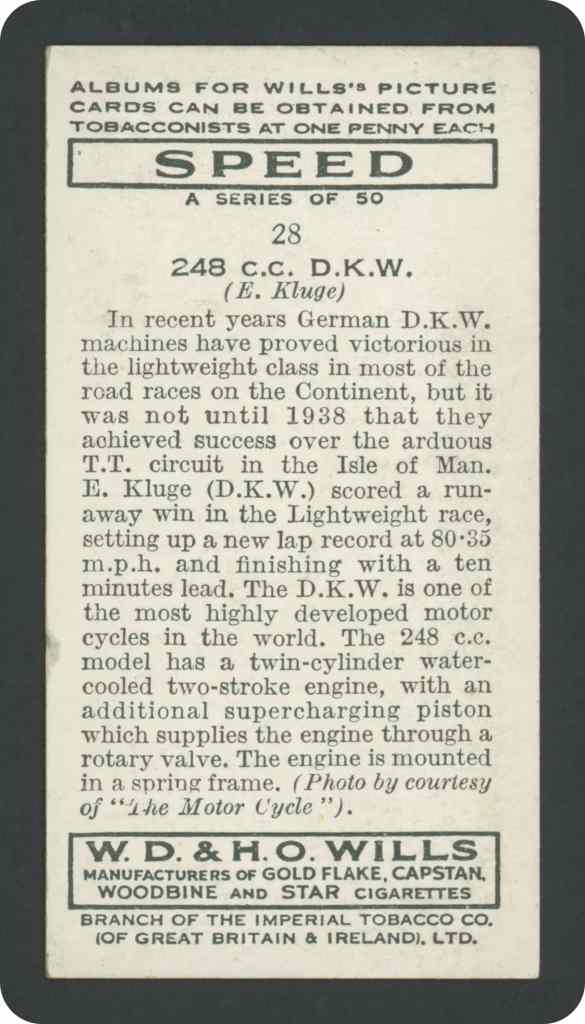
248 C.C. D.K.W.
In recent years German D.K.W. machines have proved victorious in the lightweight class in most of the road races on the Continent, but it was not until 1938 that they achieved success over the arduous T.T. circuit in the Isle of Man. E. Kluge (D.K.W.) scored a runaway win in the Lightweight race, setting up a new lap record at 80•35 m.ph. and finishing with a ten minutes lead. The D.K.W. is one of the most highly developed motor cycles in the world. The 248 c.c. model has a twin- cylinder water-cooled two-stroke engine, with an additional supercharging piston which supplies the engine through a rotary valve. The engine is mounted in a spring frame. ( Photo by courtesy of “the Motor U’ycle “).
No Variations
No Error Cards Reported

29
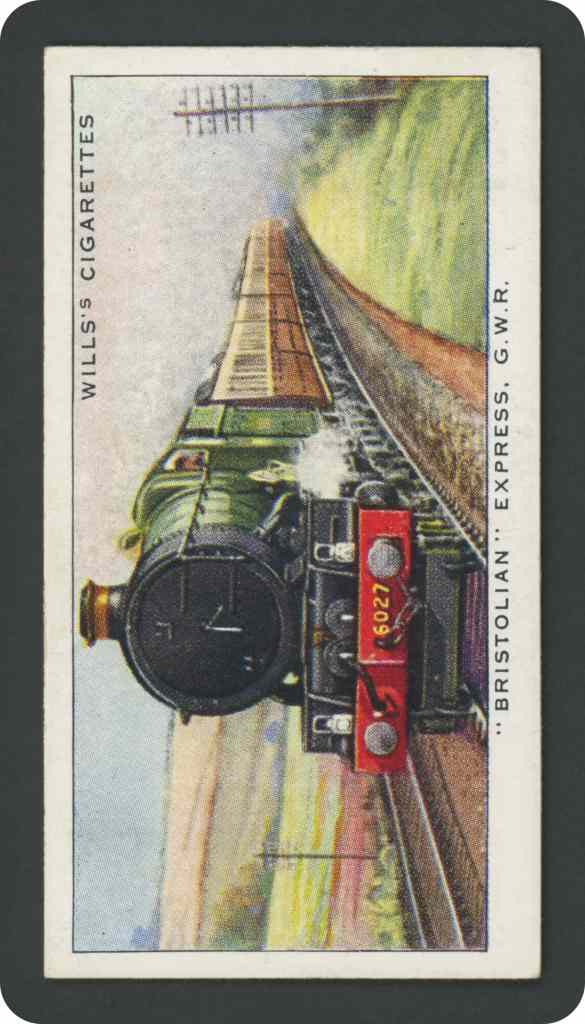
“Bristolian” Express, G.W.R.
This is the fastest train on the G.W.R. for a start-to-stop distance of over 100 miles. The “Bristolian,” which runs approximately 118 miles between Paddington and Bristol, averages 67•6 m.ph. in the down direction and 67•2 m.p.h. in the up direction. The train, which may weigh in the region of 220 tons, is hauled by a four-cylinder 4-6-0 of the ” King ” or ” Castle” classes (King Richard I is illustrated). Engines of the “Castle” class also haul the “Cheltenham Flyer,” which covers the 77•3 miles from Swindon to Paddington in 65 min. at an average of 71•4 m.ph. In keeping ordinary time the “Bristolian” may touch speeds of from 83 to 88 m.p.h. in the course of the journey.
No Variations
No Error Cards Reported
30
“Coronation Scot” Express, L.M.S.R.
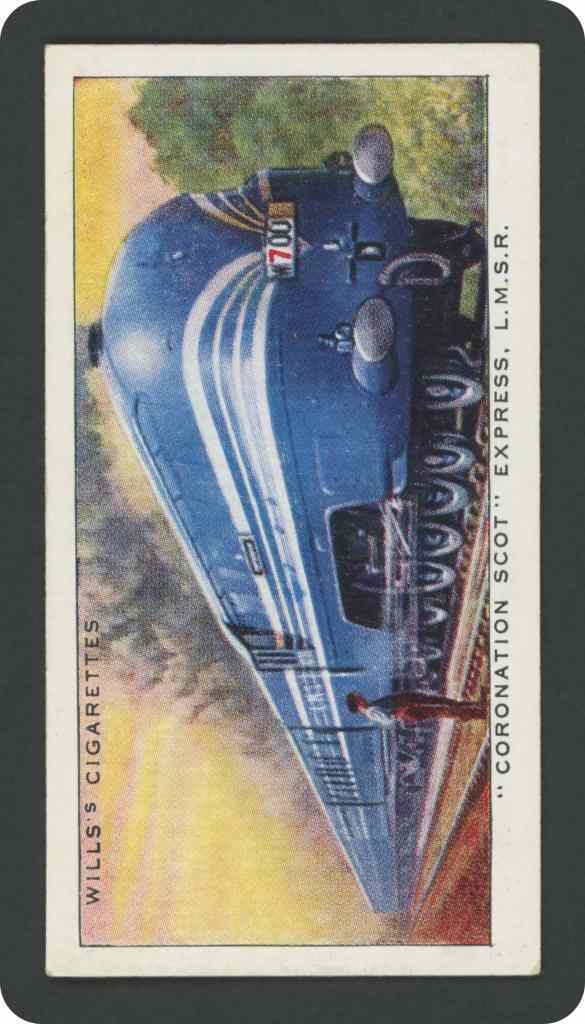
On the trial run of the L.M.S.R. “Coronation Scot” express, made on June 29th, 1937, streamlined Pacific locomotive No. 6220 Coronation, with a 263-ton train, touched 114 m.p.h., and averaged 100 m.p.h. for 10 miles on the 158•1-mile journey rom Euston to Crewe, which was completed in 129} min. The same engine and train made the return run in 119 min., averaging a fraction under 80 m.p.h. through-out, and 89 m.p.h. for 72•3 miles. These engines are four-cylinder simples with a boiler pressure of 250Ib. per square inch, and a total weight in working order of 108 tons 2 cwt. for the engine, and 164 tons 9 cwt. with the tender, complete with 10 tons of coal and 4,000 gal lons of water.
No Variations
No Error Cards Reported
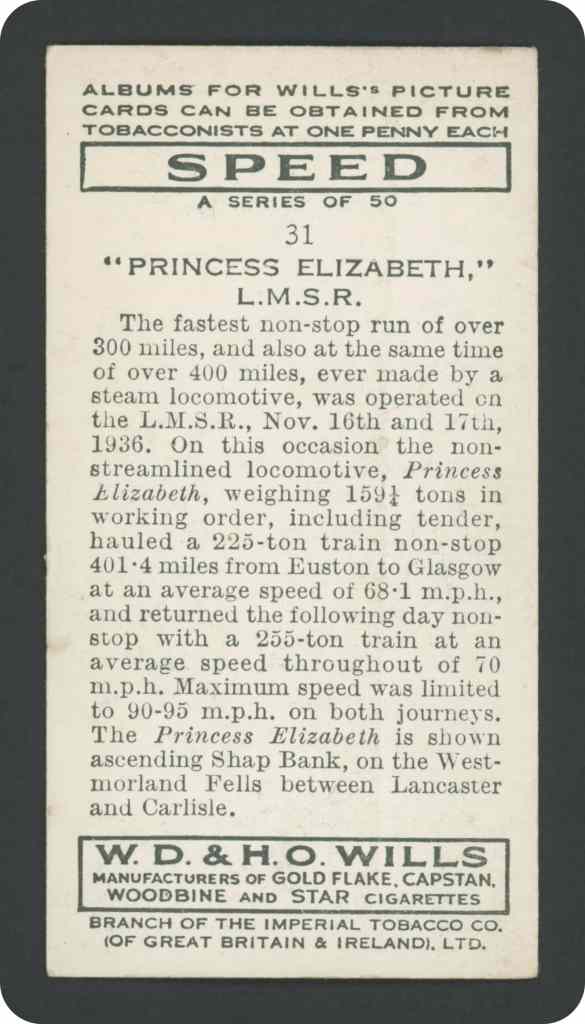
31
“Princess Elizabeth” L.M.S.R.
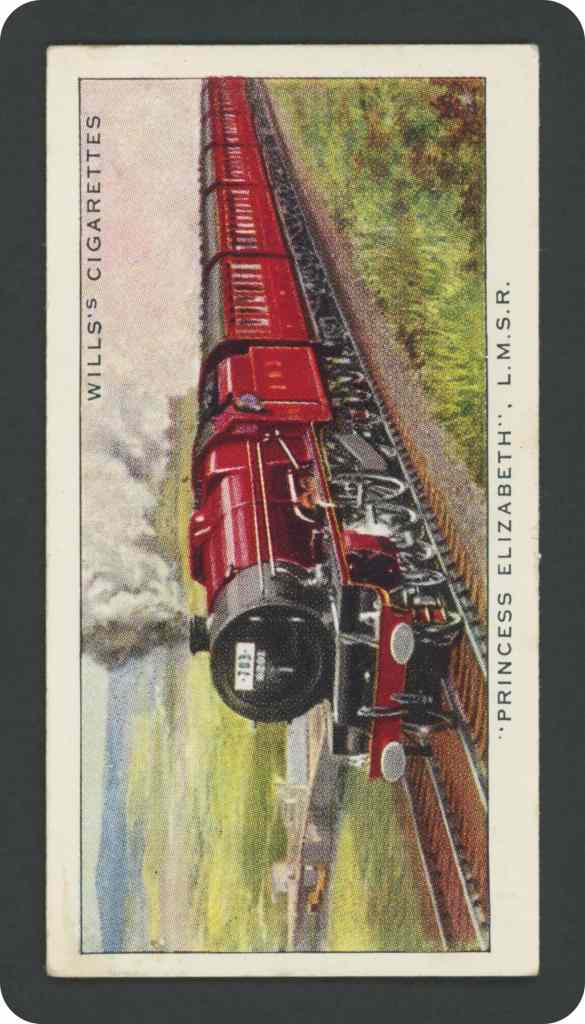
The fastest non-stop run of over 300 miles, and also at the same time of over 400 miles, ever made by a steam locomotive, was operated on the L.M.S.R., Nov. 16th and 17th, 1936. On this occasion the non-streamlined locomotive, Princess Elizabeth, weighing 159½ tons in working order, including tender, hauled a 225-ton train non-stop 401•4 miles from Euston to Glasgow at an average speed of 68•1 m.ph., and returned the following day nonstop with a 255-ton train at an average speed throughout of 70 m.p.h. Maximum speed was limited to 90-95 m.ph. on both journeys. The Princess Elizabeth is shown ascending Shap Bank, on the West-morland Fells between Lancaster and Carlisle.
No Variations
No Error Cards Reported
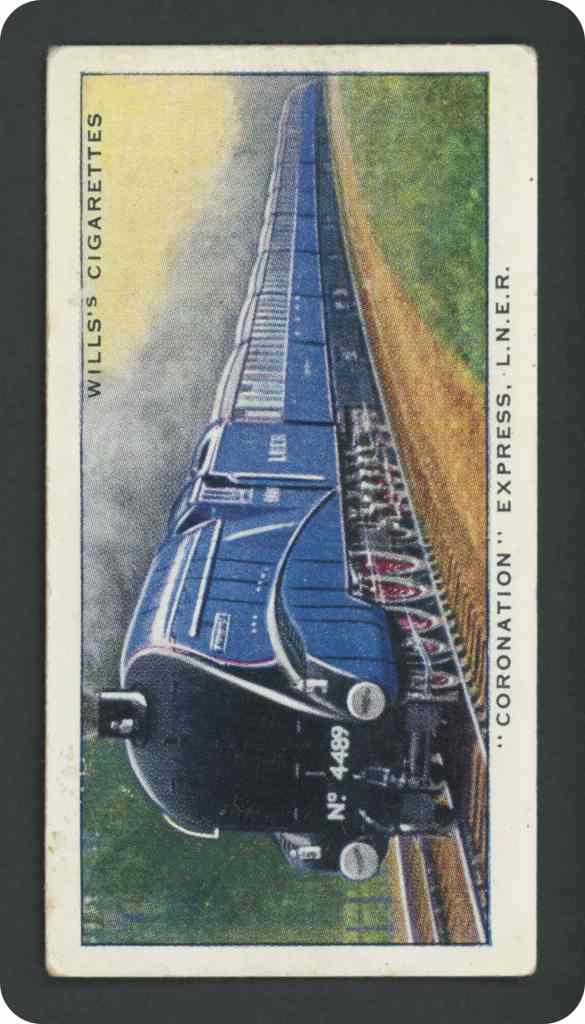
32
“Coronation” Express, L.N.E.R.
The fastest scheduled start-to-stop railway run in the British Empire is made by the L.N.E.R. express “Coronation,” which works between King’s Cross and Edinburgh. This distinction is achieved on the 188•2-mile run from King’s Cross to York, which is reached in 157 min. at an average speed of 71•9 m.p.h., the journey thence to Edinburgh being made with one intermediate stop at Newcastle. Reaching Newcastle in the up direction from Edinburgh after an average of 62 2 m.p.h., the non-stop run of 268•3 miles on to London is allowed 3 hrs. 57 min., thus averaging 67•9 m.p.h., the average throughout for both up and down runs being 65•3 m.ph. The locomotives used are streamlined Pacifics, each weighing 165 tons 7 cwt. including tender.
No Variations
No Error Cards Reported

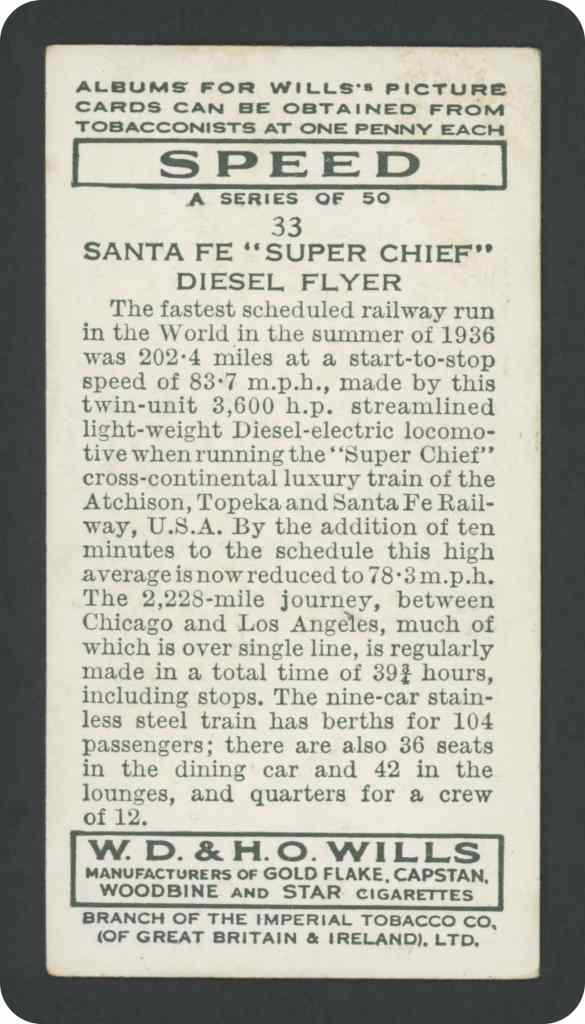
33
Santa Fe “Super Chief” Diesel Flyer
The fastest scheduled railway run in the World in the summer of 1936 was 202•4 miles at a start-to-stop speed of 83:7 m.ph., made by this twin-unit 3,600 h.p. streamlined light-weight Diesel-electric locomotive when running the “Super Chief’ cross- continental luxury train of the Atchison, Topeka and Santa Fe Rail-way, U.S.A. By the addition of ten minutes to the schedule this high average is now reduced to 78•3m.p.h. The 2,228-mile journey, between Chicago and Los Angeles, much of which is over single line, is regularly made in a total time of 391 hours, including stops. The nine-car stainless steel train has berths for 104 passengers; there are also 36 seats in the dining car and 42 in the lounges, and quarters for a crew of 12.
No Variations
No Error Cards Reported

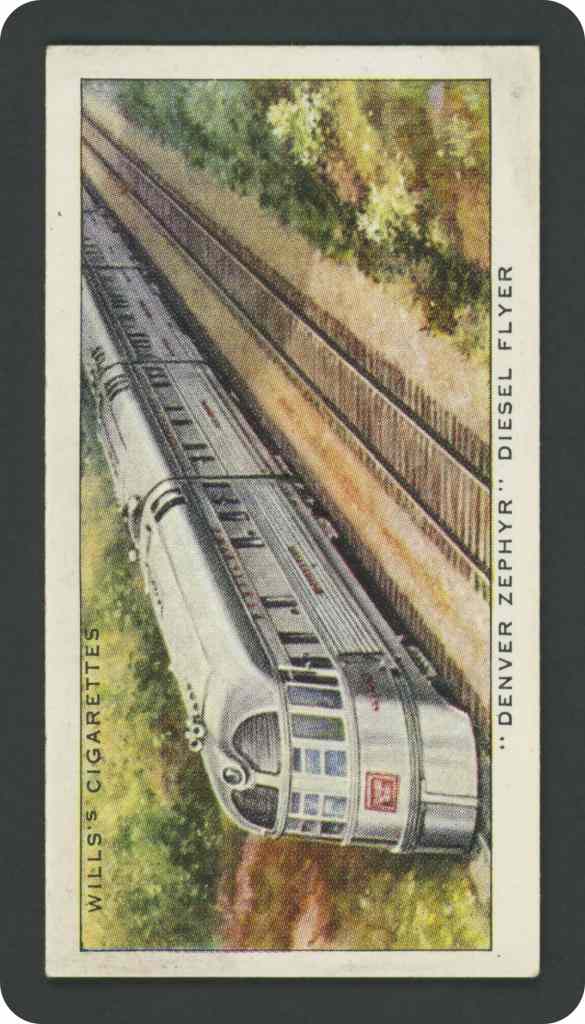
34
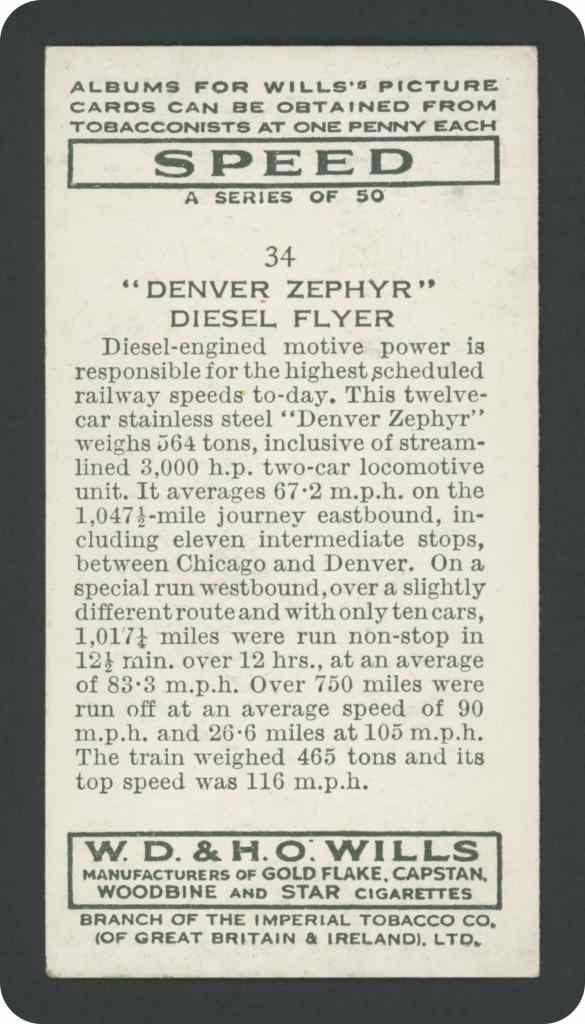
“Denver Zephyr” Diesel Flyer
Diesel-engined motive power is responsible for the highest scheduled railway speeds to-day. This twelve-car stainless steel “Denver Zephyr’ weighs J64 tons, inclusive of streamlined 3,000 h.p. two-car locomotive unit. It averages 67•2 m.p.h. on the 1,0471-mile journey eastbound, including eleven intermediate stops, between Chicago and Denver. On a special run westbound, over a slightly different route and with only ten cars, 1,0171 miles were run non-stop in 12⅓ min. over 12 hrs., at an average of 83•3 m.p.h. Over 750 miles were run off at an average speed of 90 m.p.h. and 26•6 miles at 105 m.p.h. The train weighed 465 tons and its top speed was 116 m.p.h.
No Variations
No Error Cards Reported
35
German Diesel Flyer
This flyer is one of the now fairly numerous high-speed Diesel-electric trains at work on the German State Railways, the speed of which frequently exceeds 100 m.ph. in the course of ordinary running. On the service illustrated, one two-car set reaches Nuremburg from Munchen, and the other comes from Stuttgart. Coupled together, they are then driven to Berlin. The combined train weighs 182 tons and seats 174 pas-sengers. For the 1021-mile Leipzig-Berlin section, 76 min. are allowed (averaging 80•7 m.p.h.), and the “Flying Cologner,” a similar train and the fastest in the World, runs 157•8 miles in 115 min. (averaging 82:3 m.p.h.), while the “Flying Hamburger” covers, non-stop, 178•1 miles in 137 min. (averaging 78 m.p.h.).
No Variations
No Error Cards Reported
36
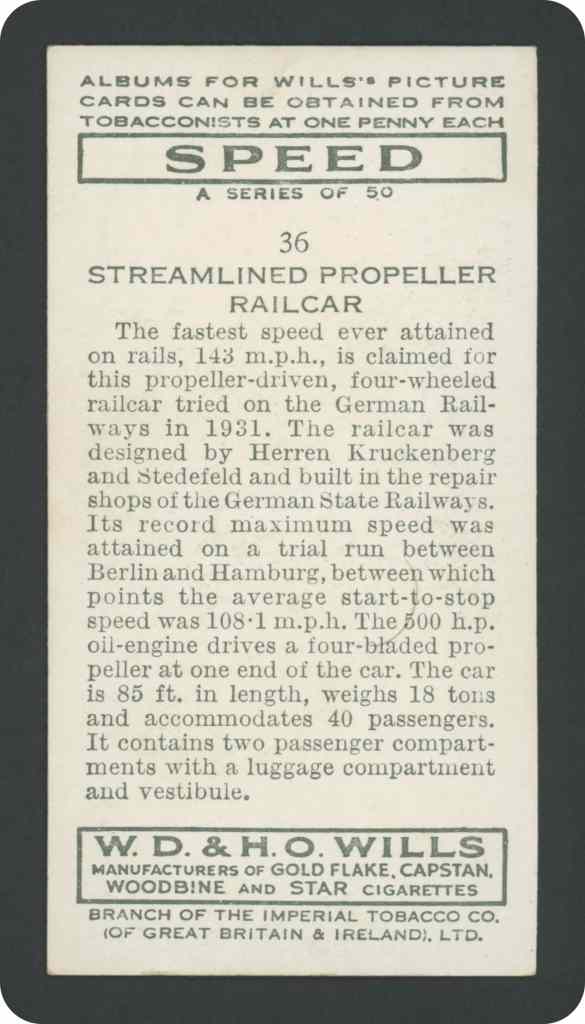
Streamlined Propeller Railcar
The fastest speed ever attained on rails, 143 m.p.h., is claimed for this propeller-driven, four-wheeled railcar tried on the German Railways in 1931. The railcar was designed by Herren Kruckenberg and Stedefeld and built in the repair shops of the German State Railways. Its record maximum speed was attained on a trial run between Berlin and Hamburg, between which points the average start-to-stop speed was 108•1 m.p.h. The 500 h.p. oil-engine drives a four-bladed propeller at one end of the car. The car is 85 ft. in length, weighs 18 tons and accommodates 40 passengers. It contains two passenger compartments with a luggage compartment and vestibule.
No Variations
No Error Cards Reported

37
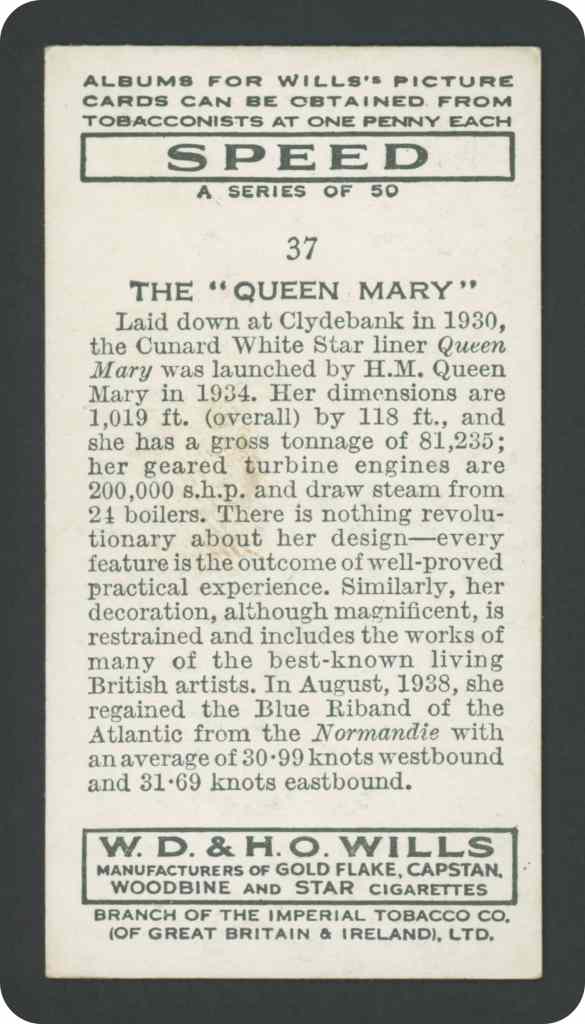
The “Queen Mary”
Laid down at Clydebank in 1930, the Cunard White Star liner Queen Mary was launched by H.M. Queen Mary in 1934. Her dimensions are 1,019 ft. (overall) by 118 ft., and she has a gross tonnage of 81,235; her geared turbine engines are 200,000 s.h.p. and draw steam from 21 boilers. There is nothing revolutionary about her design every feature is the outcome of well- proved practical experience. Similarly, her decoration, although magnificent, is restrained and includes the works of many of the best-known living British artists. In August, 1938, she regained the Blue Riband of the Atlantic from the Normandie with an average of 30•99 knots westbound and 31•69 knots eastbound.
No Variations
No Error Cards Reported

38
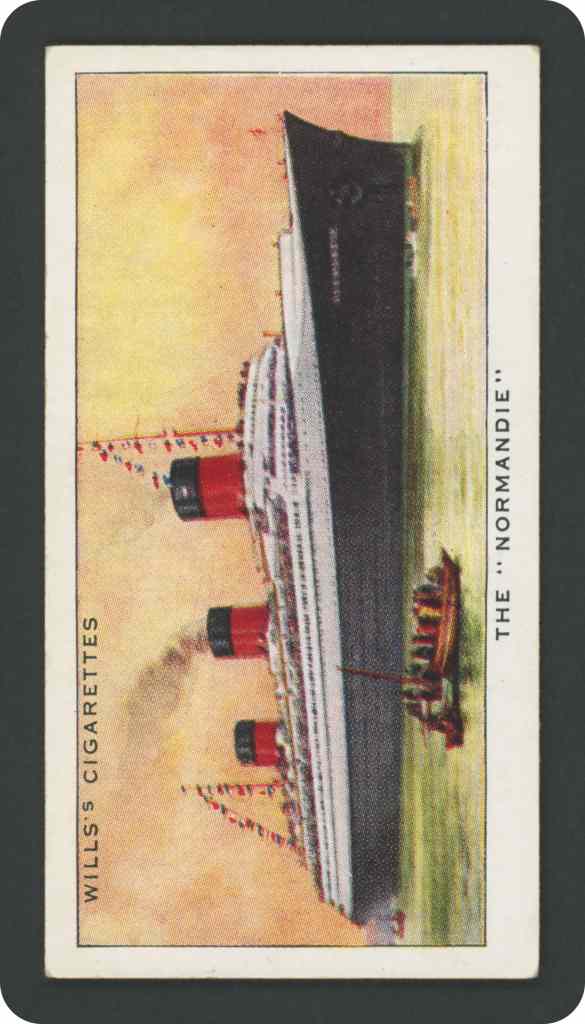
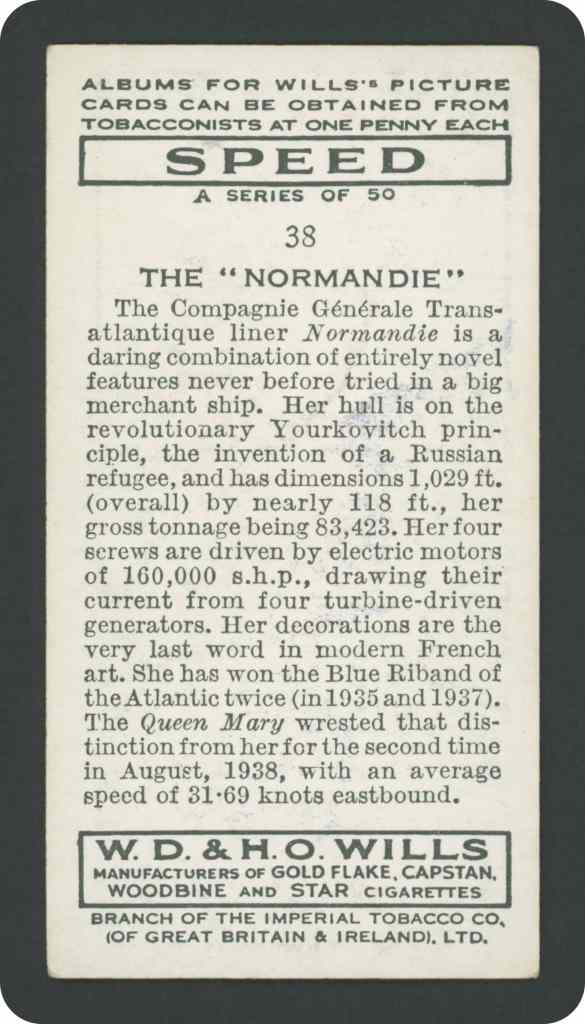
The “Normandie”
The Compagnie Générale Trans-atlantique liner Normandie is a daring combination of entirely novel features never before tried in a big merchant ship. Her hull is on the revolutionary Yourkovitch prin-ciple, the invention of a Russian refugee, and has dimensions 1,029 ft. (overall) by nearly 118 ft., . her gross tonnage being 83,423. Her four serews are driven by electric motors of 160,000 s.h.p., drawing their current from four turbine-driven generators. Her decorations are the very last word in modern French art. She has won the Blue Riband of the Atlantic twice (in 1935 and 1937). The Queen Mary wrested that distinction from her for the second time in August, 1938, with an average speed of 31•69 knots eastbound.
No Variations
No Error Cards Reported
39
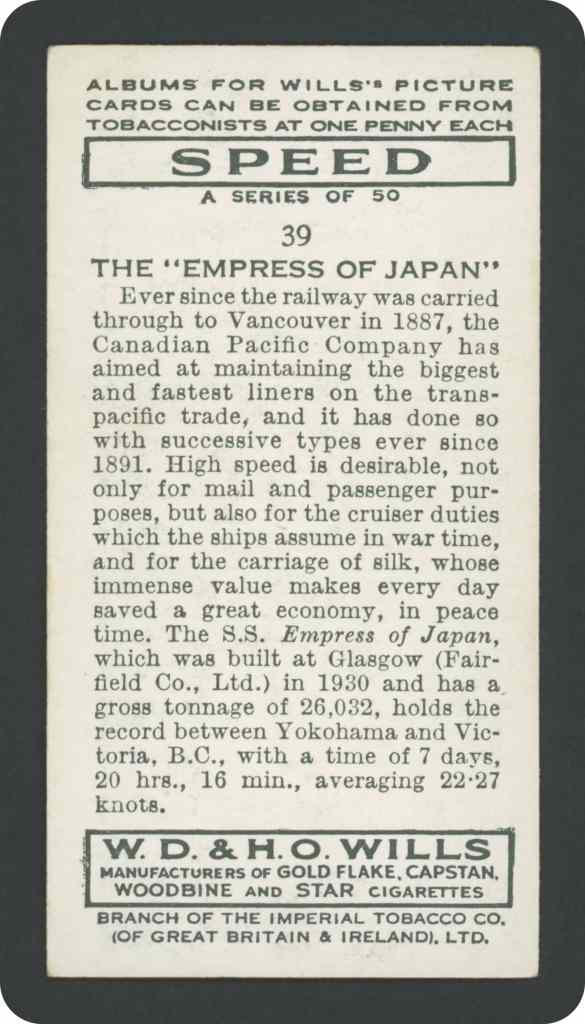
The “Express Of Japan”
Ever since the railway was carried through to Vancouver in 1887, the Canadian Pacific Company has aimed at maintaining the biggest and fastest liners on the trans-pacific trade, and it has done 80 with successive types ever since 1891. High speed is desirable, not only for mail and passenger pur-poses, but also for the cruiser duties which the ships assume in war time, and for the carriage of silk, whose immense value makes every day saved a great economy, in peace time. The S.S. Empress of Japan, which was built at Glasgow (Fair-field Co., Ltd.) in 1930 and has a gross tonnage of 26,032, holds the record between Yokohama and Vic-toria, B.C., with a time of 7 days, 20 hrs., 16 min., , averaging 22•27 knots.
No Variations
No Error Cards Reported

40
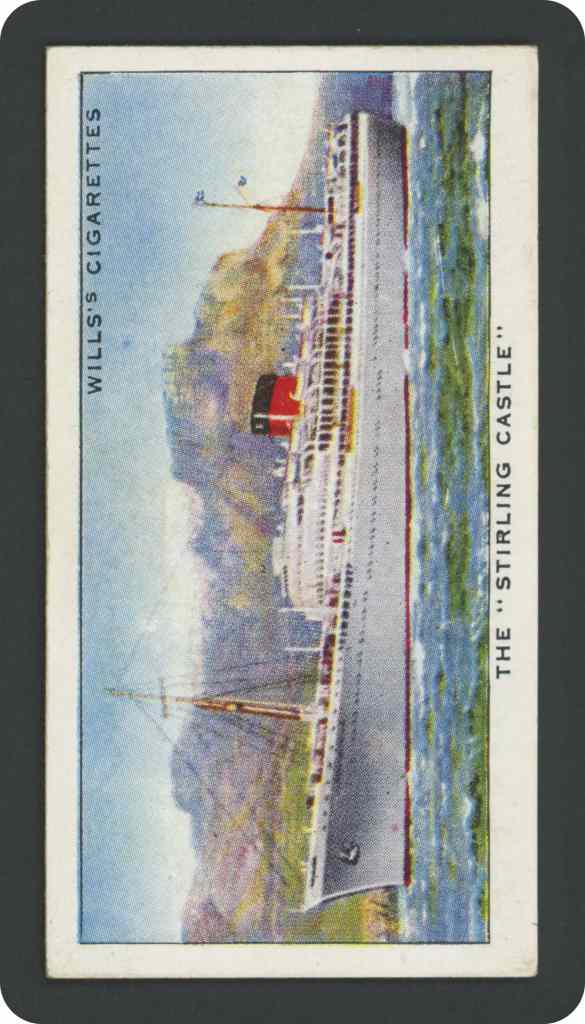
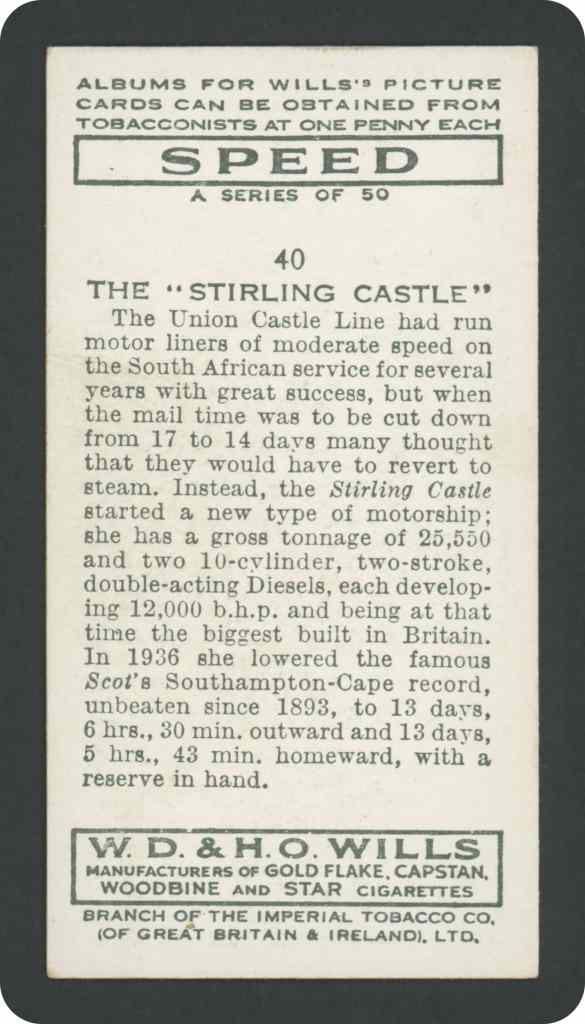
The “Stirling Castle”
The Union Castle Line had run motor liners of moderate speed on the South African service for several years with great success, but when the mail time was to be cut down from 17 to 14 days many thought that they would have to revert to steam. Instead, the Stirling Castle started a new type of motorship; she has a gross tonnage of 25,550 and two 10-cylinder, two-stroke, double-acting Diesels, each developing 12,000 b.h.p. and being at that time the biggest built in Britain. In 1936 she lowered the famous Scot’s Southampton-Cape record, unbeaten since 1893, to 13 days, 6 hrs., 30 min. outward and 13 days, 5 hrs., 43 min. homeward, with a reserve in hand.
No Variations
No Error Cards Reported
41
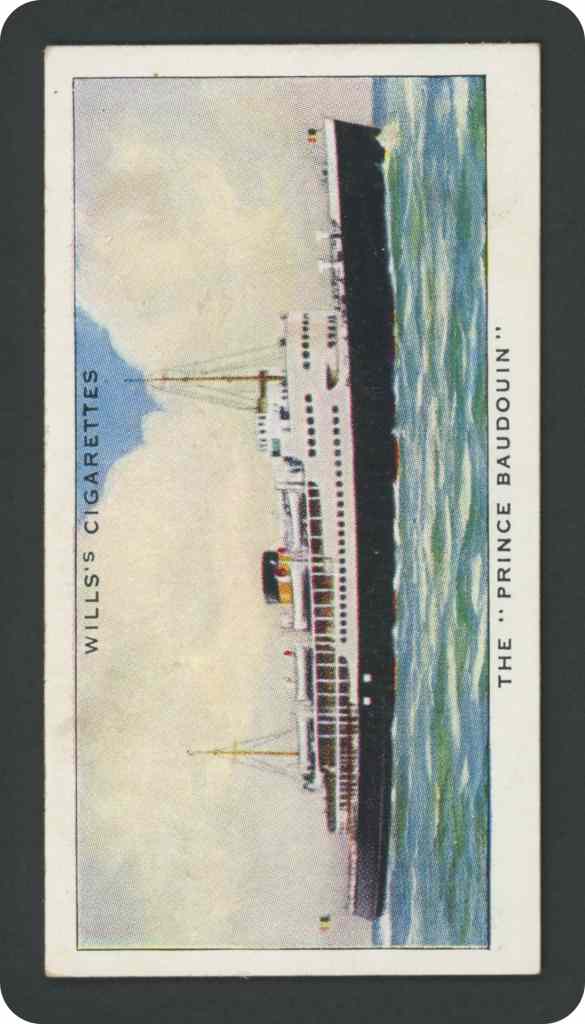
The “Prince Baudouin”
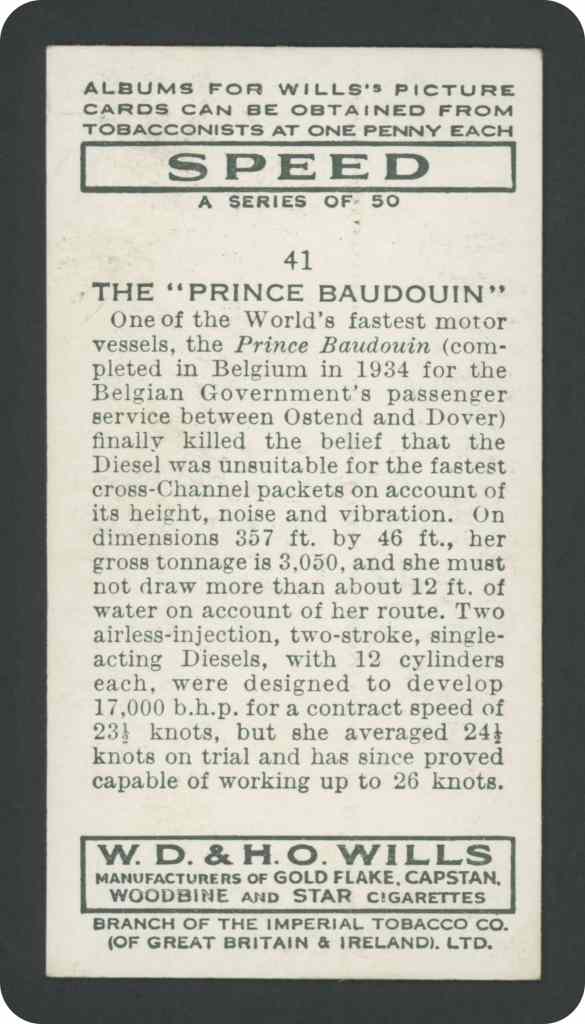
One of the World’s fastest motor vessels, the Prince Baudouin (com-pleted in Belgium in 1934 for the Belgian Government’s passenger service between Ostend and Dover) finally killed the belief that the Diesel was unsuitable for the fastest cross- Channel packets on account of its height, noise and vibration. On dimensions 357 ft. by 46 ft., her gross tonnage is 3,050, and she must not draw more than about 12 ft. of water on account of her route. Two airless-injection, two-stroke, single-acting Diesels, with 12 cylinders each, were designed to develop 17,000 b.h.p. for a contract speed of 231 knots, but she averaged 24% knots on trial and has since proved capable of working up to 26 knots.
No Variations
No Error Cards Reported
42
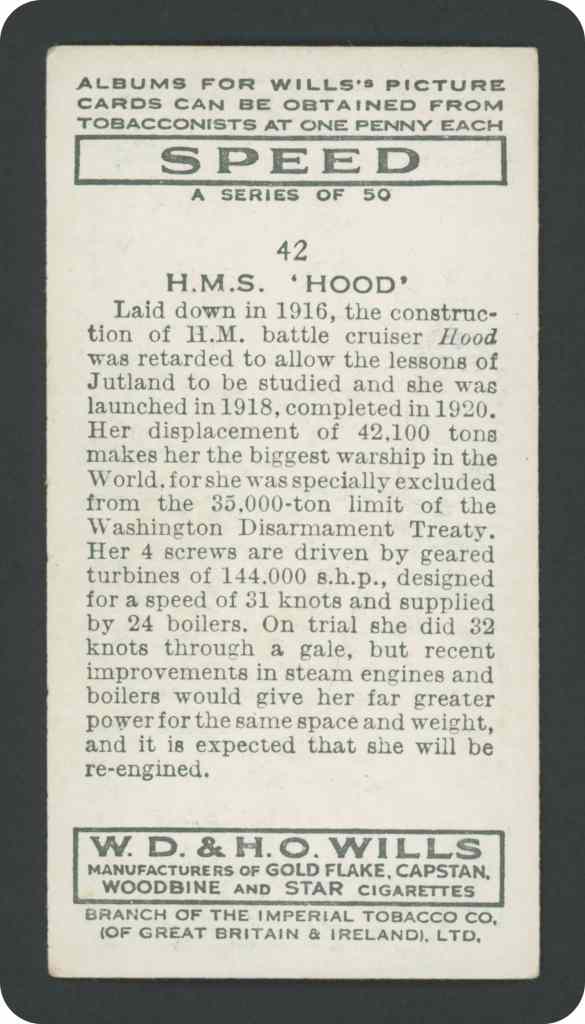
H.M.S. “Hood”
Laid down in 1916, the construc tion of H.M. battle cruiser Hood was retarded to allow the lessons of Jutland to be studied and she was launched in 1918, completed in 1920. Her displacement of 42,100 tons makes her the biggest warship in the World, for she was specially excluded from the 35,000-ton limit of the Washington Disarmament Treaty. Her 4 screws are driven by geared turbines of 144.000 s.h.p., , designed for a speed of 31 knots and supplied by 24 boilers. On trial she did 32 knots through a gale, but recent improvements in steam engines and boilers would give her far greater power for the same space and weight, and it is expected that she will be re-engined.
No Variations
No Error Cards Reported

43
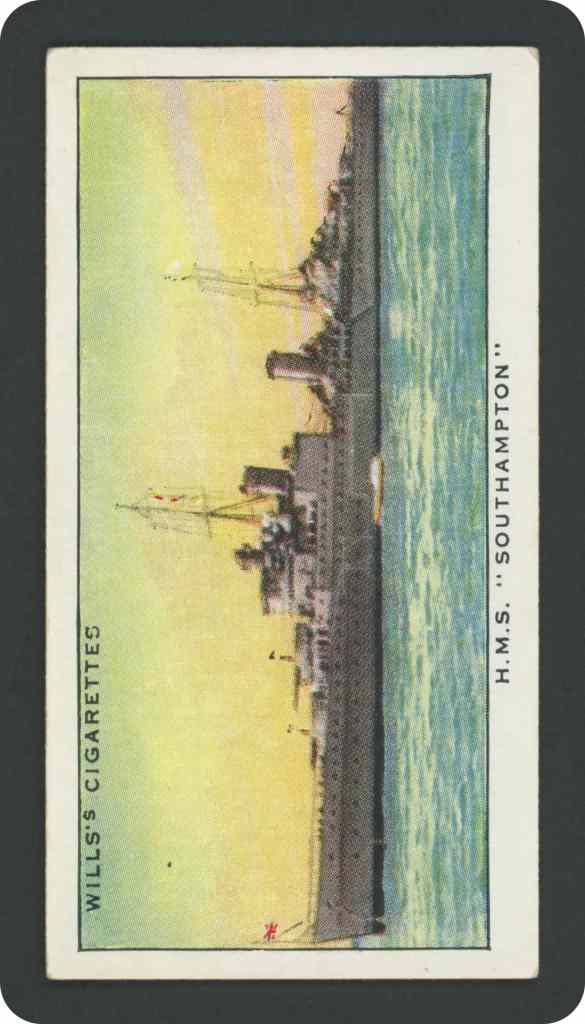
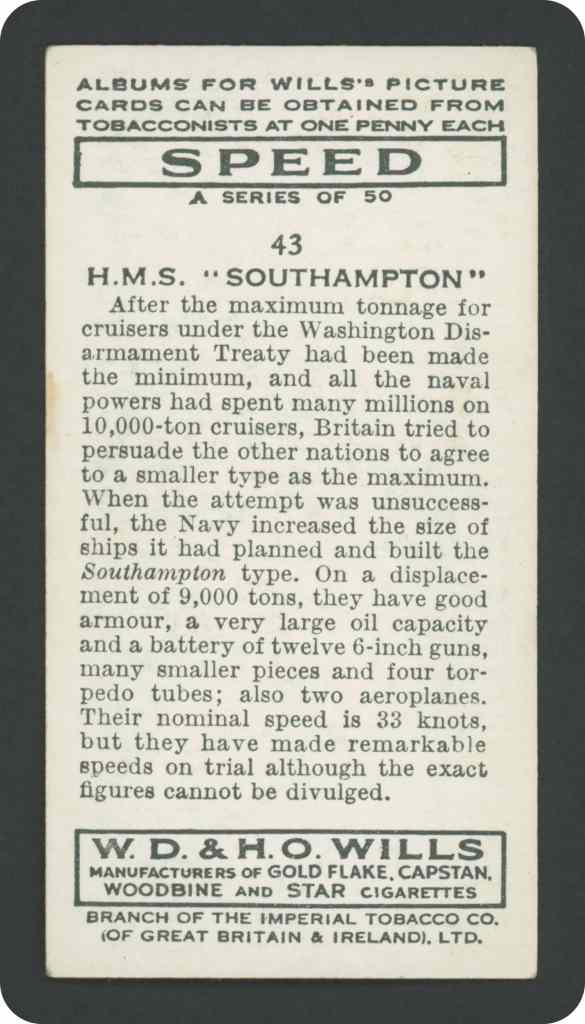
H.M.S. “Southhampton”
After the maximum tonnage for cruisers under the Washington Disarmament Treaty had been made the minimum, and all the naval powers had spent many millions on 10,000-ton cruisers, Britain tried to persuade the other nations to agree to a smaller type as the maximum. When the attempt was unsuccess-ful, the Navy increased the size of ships it had planned and built the Southampton type. On a displacement of 9,000 tons, they have good armour, a very large oil capacity and a battery of twelve 6-inch guns, many smaller pieces and four torpedo tubes; also two aeroplanes. Their nominal speed is 33 knots, but they have made remarkable speeds on trial although the exact figures cannot be divulged.
No Variations
No Error Cards Reported
44
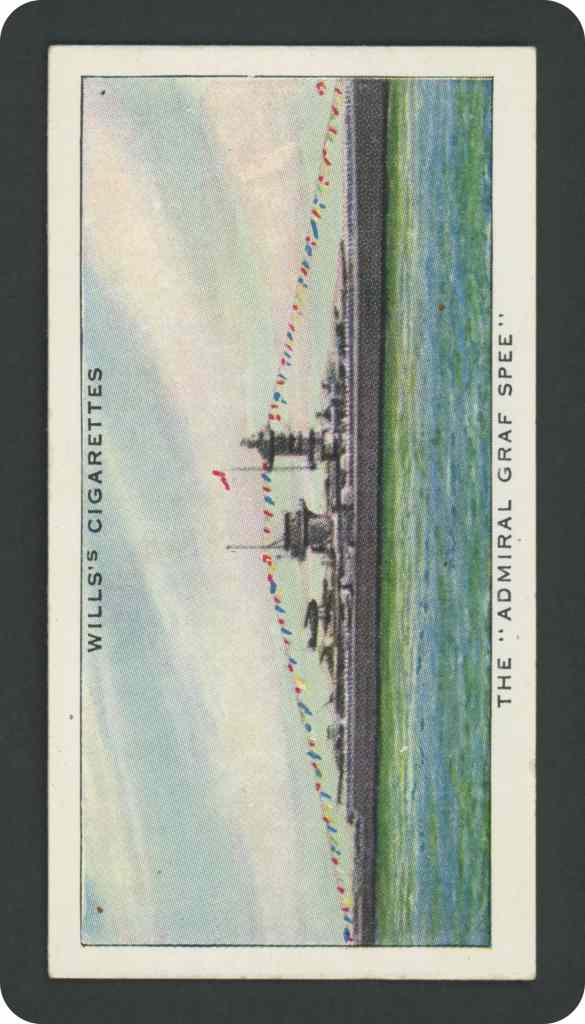
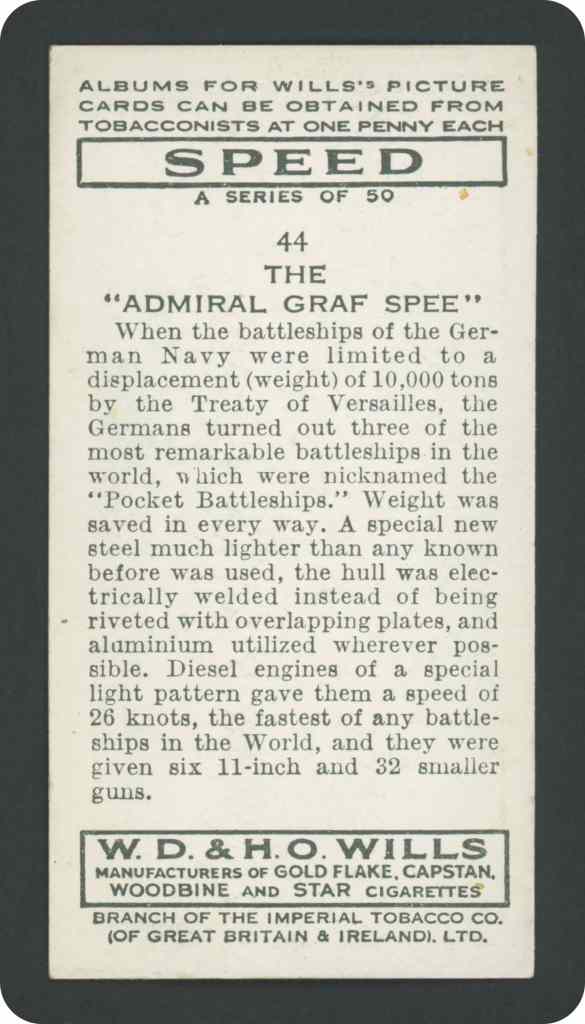
The “Admiral Graf Spee”
When the battleships of the German Navy were limited to a displacement (weight) of 10,000 tons by the Treaty of Versailles, the Germans turned out three of the most remarkable battleships in the world, which were nicknamed the “Pocket Battleships.” Weight was saved in every way. A special new steel much lighter than any known before was used, the hull was electrically welded instead of being riveted with overlapping plates, and aluminium utilized wherever pog-sible. Diesel engines of a special light pattern gave them a speed of 26 knots, the fastest of any battleships in the World, and they were given six 11-inch and 32 smaller guns.
No Variations
No Error Cards Reported
45
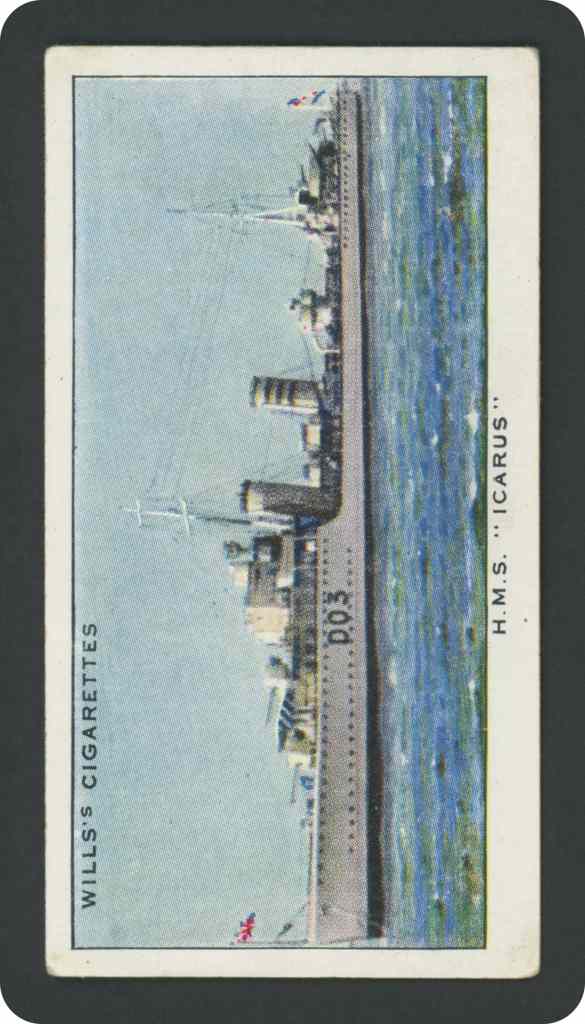
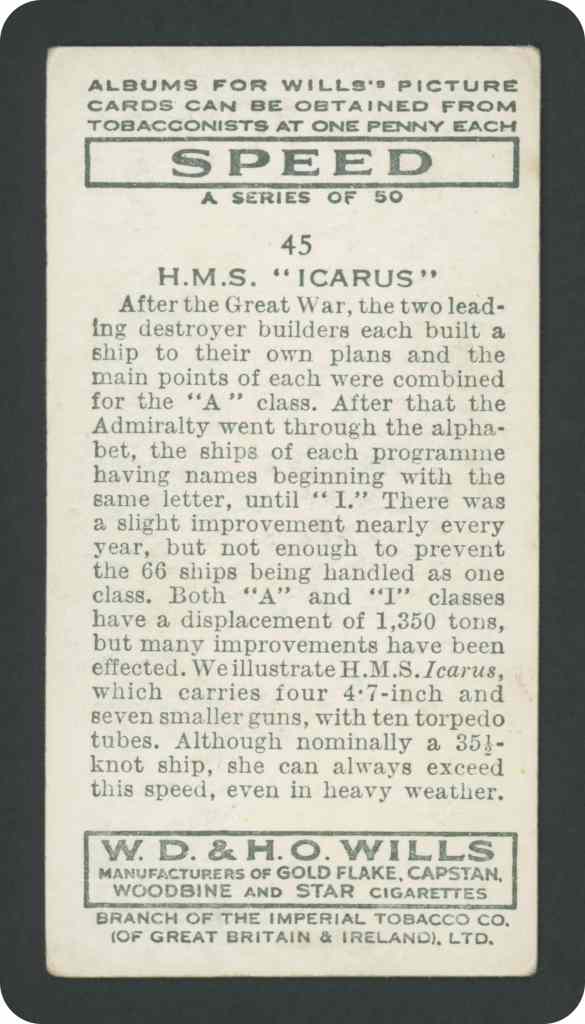
H.M.S. “Icarus”
After the Great War, the two leading destroyer builders each built a ship to their own plans and the main points of each were combined for the “A ” class. After that the Admiralty went through the alpha-bet, the ships of each programme having names beginning with the same letter, until “I.” There was a slight improvement nearly every year, but not enough to prevent the 66 ships being handled as one class. Both “A” and “I’ classes have a displacement of 1,350 tons, but many improvements have been effected. Weillustrate H.M.S. Icarus, which carries four 47-inch and seven smaller guns, with ten torpedo tubes. Although nominally a 351-knot ship, she can always exceed this speed, even in heavy weather.
No Variations
No Error Cards Reported
46
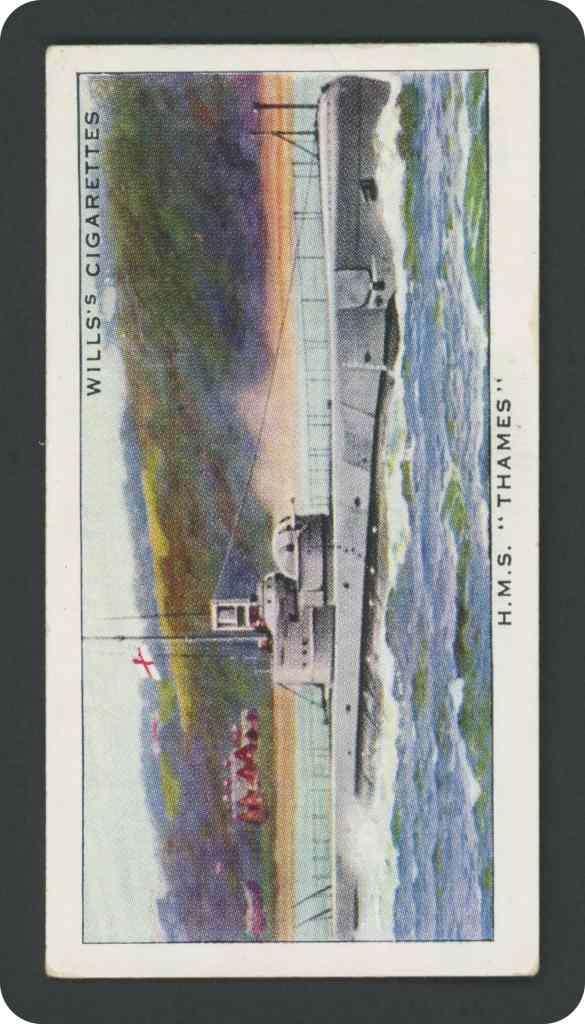
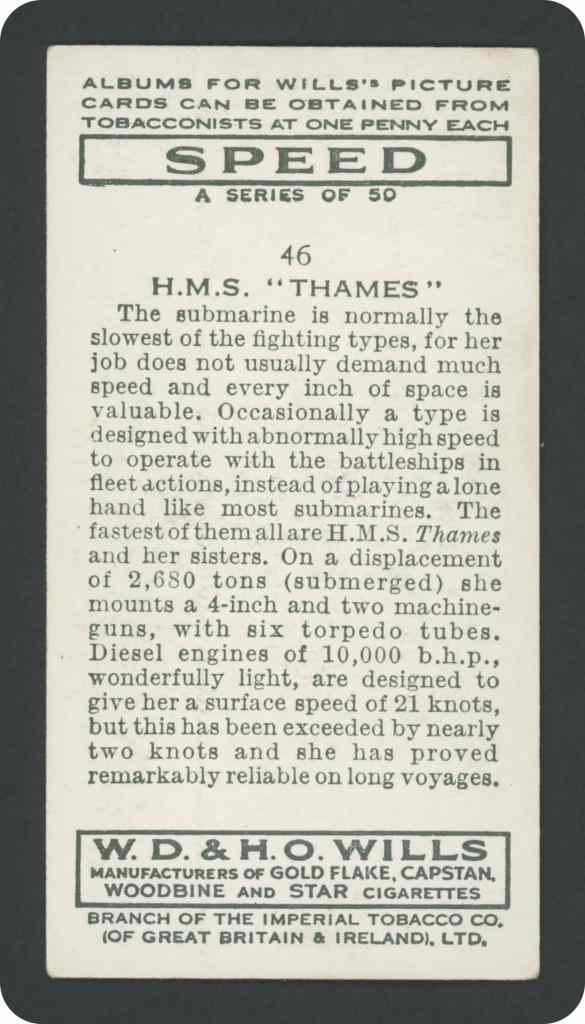
H.M.S. “Thames”
The submarine is normally the slowest of the fighting types, for her job does not usually demand much speed and every inch of space is valuable. Occasionally a type is designed with abnormally high speed to operate with the battleships in fleet actions, instead of playing a lone hand like most submarines. The fastest of them all are H.M.S. Thames and her sisters. On a displacement of 2,680 tons (submerged) she mounts a 4-inch and two machine-guns, with six torpedo tubes. Diesel engines of 10,000 b.h.p., wonderfully light, are designed to give her a surface speed of 21 knots, but this has been exceeded by nearly two knots and she has proved remarkably reliable on long voyages.
No Variations
No Error Cards Reported
47
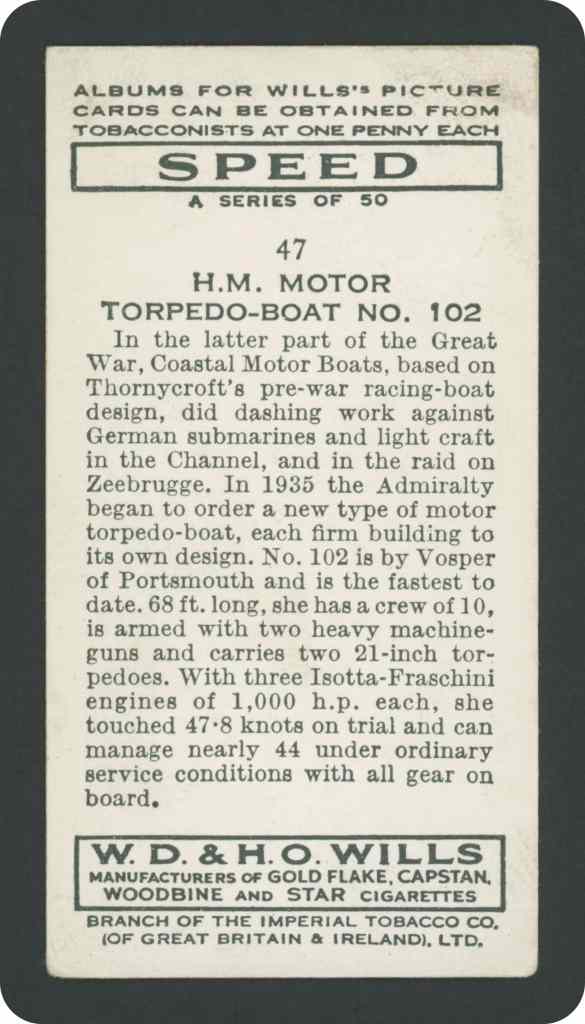
H.M. Motor Torpedo-Boat No. 102
In the latter part of the Great War, Coastal Motor Boats, based on Thornycroft’s pre-war racing-boat design, did dashing work against German submarines and light craft in the Channel, and in the raid on Zeebrugge. In 1935 the Admiralty began to order a new type of motor torpedo-boat, each firm building to its own design. No. 102 is by Vosper of Portsmouth and is the fastest to date. 68 ft. long, she has a crew of 10, is armed with two heavy machine-guns and carries two 21-inch tor-pedoes. With three Isotta-Fraschini engines of 1,000 h.p. each, she touched 47•8 knots on trial and can manage nearly 44 under ordinary service conditions with all gear on board.
No Variations
No Error Cards Reported

48
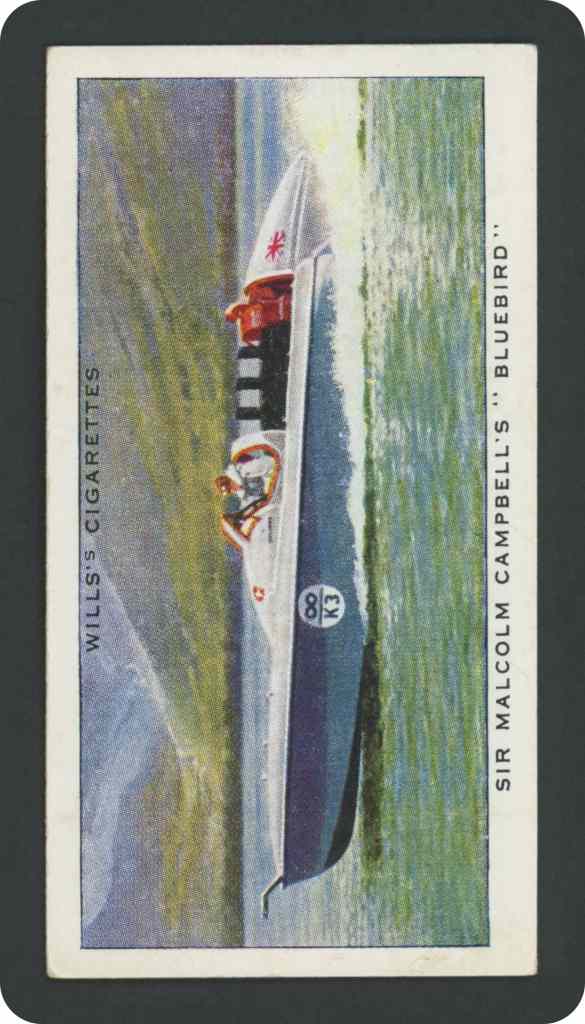
Sir Malcolm Campbell’s “Bluebird”
When Sir Malcolm Campbell set out to break the World water speed record he christened his motor-boat Bluebird, the same name as the car with which he broke the World record on land. Her engine is a 2,000 h.. 12-cylinder Rolls-Royce, similar to that in the car. 23 ft. in length by 9 ft. 6 in. beam, she weighs 2⅓ tons and was built of mahogany by Saunders-Roe, Ltd., of Cowes. On September 17th, 1938, Sir Malcolm Campbell broke his own World record of 129•5 m.p.h. (set up in August, 1937) by maintaining an average speed of 130•91 m.p.h. on Lake Hallwil, Switzerland.
No Variations
No Error Cards Reported
49
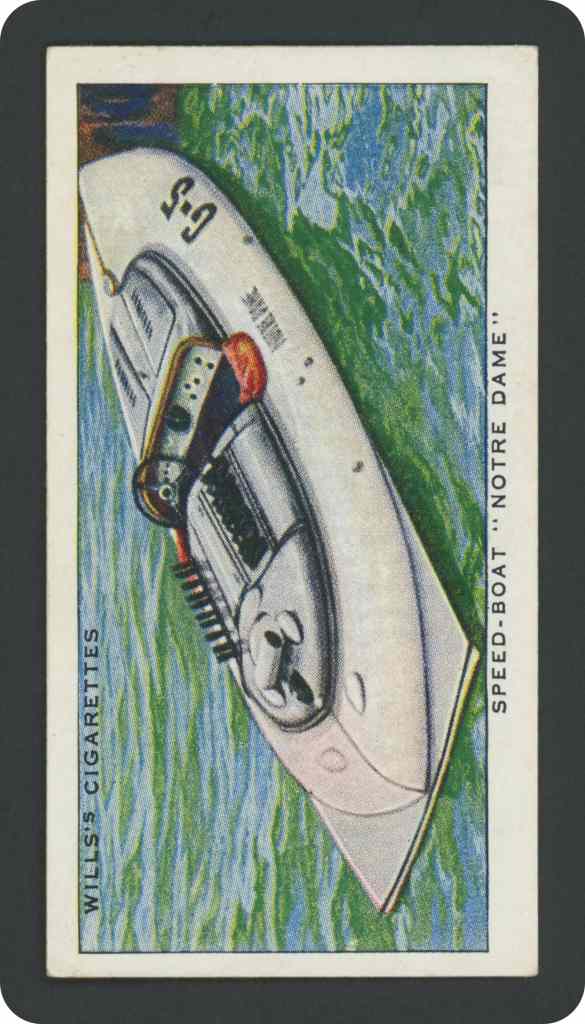
Speed-Boat “Notre Dame”
Built in 1935, the famous American speed-boat Notre Dame embodies many novel features which caused a great deal of discussion when she first made her appearance, but which have been generally justified since. One of these was the careful streamlining aft over a broad raft-like stern, to check the tendency to “sit down’ at high speed. A 24-cylinder Dusenburg engine is fitted. Owned by Mr. Herbert Mendelsohn, she is usually raced by Cell Perry. Her most famous success was the International Gold Cup at Detroit in 1937 against 10 rivals. She averaged 63•675 land miles per hour in three 30-mile heats, handicapped by the fact that the course was only three miles round with constant helm checking speed.
No Variations
No Error Cards Reported
50
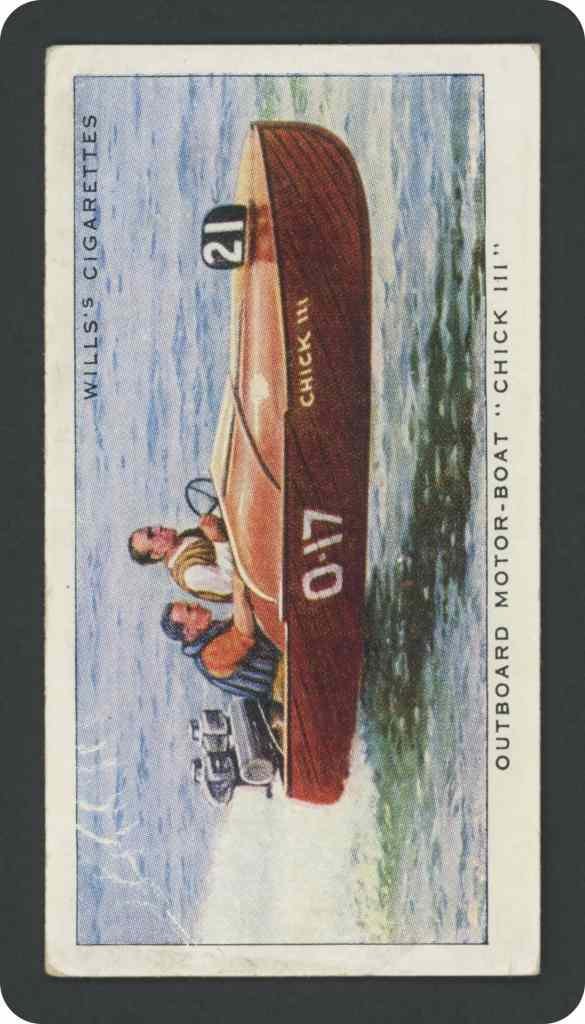
Outboard Motor-Boat “Chick III”
The idea that the excitement of high speed on the water is attainable only at great expense is quite wrong. Outboard motor- boats can give as many thrills as any other type, in fact, more than most on account of their small size and very lively motion. Chick IlI is 12 ft. 6 in. long by 4 ft. 8 in. beam, built of silver spruce and weighing 180 lb. without its motor; the latter is a 2- cylinder Johnson outboard, developing 22 h.p. at 4,500 revolutions per minute. 36 m.ph. is remarkable for such a tiny craft, and with Mr. H. C. Notley handling her, many records and trophies stand to her credit. Yet she is reasonably-priced (£140) and “all out” uses only 4 gallons of petrol per hour.
No Variations
No Error Cards Reported

 Marshall Hills
Leave a comment